In our first essay, we questioned whether the number we call our age might actually represent something much more valuable: our Success Score.
Now let's consider what happens when we get the accounting wrong.
Because an incorrect valuation becomes something far more consequential when people begin making decisions based upon it.
And when the person being incorrectly valued is a human being, the cost can be substantial.
The Serious Consequences of Addition Errors
Imagine a business that continually records depreciation but fails to recognize the value of its new assets.
Its financial statements may be perfectly organized.
Its calculations may even be mathematically correct.
But the picture they present is fundamentally incomplete.
Now imagine decisions being made from that picture.
Opportunities are declined.
Investments are postponed.
Capabilities remain unused.
The error has created losses that didn't need to occur.
Isn't that remarkably similar to what happens when we use chronological age to evaluate human capability?
We begin making decisions about people based on what we assume their age means rather than what we've actually observed.
An employer may overlook someone because they're supposedly too young to lead.
Someone may abandon the possibility of a new career because they've decided they're too old.
A person may stop pursuing a physical skill because they've accepted the expectation that it no longer belongs to someone their age.
These erroneous conclusions aren't confined to any particular age group.
Someone can be considered too young at twenty-three, too old for a new career at forty-five, or past their physical prime at thirty-five.
Different numbers.
The same accounting error.
We're making decisions about capabilities we haven't actually examined.
The Cultural Cost
I suspect the consequences reach further than we recognize.
I believe the painful awareness of these dismissive judgments helps fuel something deeply embedded in American culture: our obsession with youth, longevity, and outrunning the clock.
We learn that certain ages are desirable, others are suspect, and still others are treated as warnings.
We begin organizing our expectations around the number.
What should I have accomplished by thirty?
Am I too late to begin again at forty-five?
What will people assume about me at sixty?
And what happens when we begin believing those assumptions ourselves?
The concern isn't simply that we may feel differently about our age.
We make decisions around an imagined Depreciation Schedule.
We decline an opportunity in advance.
We stop practicing something that brings joy.
We mistake an unfamiliar challenge as evidence of limitation.
We can create the very limitations we believe we're merely observing.
Of course, real limitations exist. Human capabilities change, and not every possibility remains available indefinitely.
But an assumption about age is not evidence that a particular capability has disappeared.
What We See at Swan
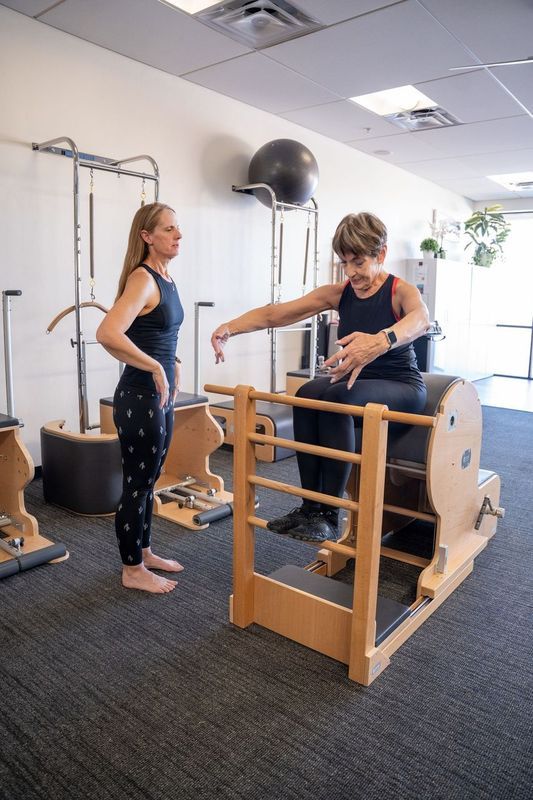
At Swan Pilates, we work with adults across different stages of life.
And here's something I've learned through teaching.
A person's age doesn't tell us what their body is capable of, what they need to develop, or how they might progress.
It takes more to meet people where they actually are than assigning everyone an exercise simply because it's on the class plan.
Put a dozen people on Reformers, get those springs moving, and you've certainly created activity.
But movement isn't necessarily development.
As I've explored in the Swan Essay Library's What Does It Mean to Be Capable?, capability is something we must understand and develop—not simply assume from someone's age or their participation in exercise.
In my opinion, when volume becomes more important than individual capability, we've made another accounting error.
And there's another.
Reducing Joseph Pilates' body of work to a single piece of apparatus is an incomplete accounting of the system itself.
That's why Swan is a client-centered, anatomy-informed Pilates studio, equipped with the complete Pilates apparatus system and teachers who embrace the craft of teaching.
The Reformer has an important place.
But the Cadillac, Wunda Chair, Barrel, Spine Corrector, and Mat provide additional possibilities for teaching and developing movement.
And the same individual may benefit from different apparatus, exercises, and teaching approaches as their capabilities develop.
The equipment isn't simply a collection of exercise options.
It gives skilled teachers choices to support their clients' development.
Choices about how to introduce a movement, adjust its demands, develop a capability, or respond when something isn't working.
Two people of the same age may arrive with entirely different capabilities.
Two people decades apart may discover they're working toward remarkably similar goals.
Their chronological ages don't determine what we teach them.
The individual does.
At Swan, the question isn't how old are you?
It's what are you capable of—and what might become possible from here?
The Cost of What Never Happens
There's another consequence of age-based assumptions that deserves attention.
We can usually recognize an opportunity that was offered and declined.
But how do we account for an opportunity that was never offered?
A skill never attempted?
A contribution never invited?
A possibility never investigated?
The individual may lose something valuable.
But so might everyone who could have benefited from that person's participation.
An organization may lose a capable contributor.
A profession may overlook an unconventional talent.
A community may never receive the benefit of someone's knowledge.
And the individual may never discover a capability that could have changed the direction of their life.
The loss isn't always a capability that disappeared. Sometimes it's a capability that never had the opportunity to appear.
Reclaiming the Authority
We've seen what can happen when we allow math errors to influence our decisions.
Opportunities are declined.
Capabilities go unexplored.
Possibilities disappear before they're even considered.
But here's something worth recognizing.
We don't have to participate in an inaccurate accounting of anyone, including ourselves.
We can question conclusions.
We can examine methods.
We can investigate something unfamiliar simply for the sake of investigation.
Accuracy is liberating.
Warmly,
Susan
Evidence Behind the Ideas
The Central Recognition
Chronological age is an accurate measure of elapsed time, but it is not a complete assessment of an individual's capability.
Age-based assumptions can influence social judgments, opportunities, and personal decisions. When those assumptions substitute for examining the individual, they may restrict participation and development.
The essay's proposed relationship between American culture's preoccupation with youth and the fear of age-based judgments is Susan Swan's interpretation, not a causal finding established by the research below.
Research Behind the Recognition
Americans Harbor Much Less Favorable Explicit Sentiments Toward Young Adults Than Toward Older Adults
This research examined attitudes toward young, middle-aged, and older adults in American samples.
The findings challenge the assumption that negative age-related judgments are directed exclusively toward older people.
Why it matters: Age-based valuations can disadvantage adults at different stages of life. A person's chronological age may trigger assumptions unrelated to their demonstrated capabilities.
The research examines expressed attitudes, not whether every such attitude results in a denied opportunity.
Too Young to Lead? Role Incongruity Explains Age Bias Against Young Leaders
This research investigates how expectations about leadership roles can influence judgments of younger adults' suitability to lead.
Why it matters: The perception that someone is the wrong age for an opportunity can affect how their potential is evaluated, independently of a direct assessment of their capability.
The findings concern leadership judgments and should not be generalized automatically to every profession or form of age discrimination.
Foundational Research Connections
Self-Efficacy: Toward a Unifying Theory of Behavioral Change
Bandura's work examines how beliefs about personal capability influence whether people initiate activities, persist, and respond to difficulty.
It provides a theoretical foundation for the essay's discussion of how internalized assumptions may influence behavior.
Conservation of Resources: A New Attempt at Conceptualizing Stress
Hobfoll's framework examines how people acquire, protect, and sometimes lose resources.
It informs the essay's accounting metaphor without implying that human resources necessarily increase with every passing year.
Suggested Reading
- Francioli, S., Shakeri, A., & North, M. S. (2024). Americans Harbor Much Less Favorable Explicit Sentiments Toward Young Adults Than Toward Older Adults .
- Daldrop, C., Homan, A., & Buengeler, C. (2025). Too Young to Lead? Role Incongruity Explains Age Bias Against Young Leaders .
- Bandura, A. (1977). Self-Efficacy: Toward a Unifying Theory of Behavioral Change .
- Hobfoll, S. E. (1989). Conservation of Resources: A New Attempt at Conceptualizing Stress .
Research informs our thinking. Life gives it meaning.