There's a curious little custom we have.
We attach a number to ourselves and call it our age.
And that number begins doing things we never realized we authorized it to do.
People hear it and make assumptions about us.
We look at it and form expectations of our own.
What we should be interested in.
What we can "reasonably" expect of ourselves.
What we may or may not be capable of.
And sometimes, sadly, what we should stop attempting.
That's an extraordinary amount of authority to give a number.
Another Revolution Around the Sun
Every year, our planet completes another journey around the sun.
And we go along for the ride.
Through changing circumstances, unexpected events, ordinary days, remarkable encounters, disappointments, discoveries, decisions, and opportunities.
Some revolutions are revolutionary and exhilarating. Others require everything we know just to stay on the planet.
Yet each completed revolution represents something remarkable.
We participated.
We encountered life.
We drew upon past skills and what we already knew, made decisions with the information available, discovered things we hadn't known before, and found our way through circumstances we couldn't necessarily have anticipated.
Sometimes we handled things beautifully.
Sometimes we made a spectacular mess.
Sometimes we didn't know what to do until we'd already done something else.
That's how experience works.
And yet, when another revolution is completed, what do we do?
We add one to the total.
Why?
Because it makes the math simple.
But convenient arithmetic isn't necessarily accurate accounting.
We've recorded another year without accounting for the victories, discoveries, and capabilities accumulated along the way.
That's a rather serious accounting error!
Our circumnavigation number
Let's explore how we might interpret the circumnavigation number differently.
Instead of seeing it as a measurement of how much time has passed, what if we recognized it as a record of how much life we've participated in?
Eighteen revolutions.
Twenty-six.
Forty-three.
Sixty-eight.
Eighty-nine.
Every number represents an extraordinary accumulation of encounters with life.
And every completed revolution contains victories far greater in number than the single year we add to our age.
Some victories are obvious.
Others are so ordinary that we barely notice them.
Imagine just how many...
Difficult conversations were navigated.
New skills acquired.
Unexpected circumstances met with something we learned years earlier.
Decisions made with greater understanding than we once possessed.
We rarely count these things.
Yet they are part of what each revolution represents.
Think about the person you were ten revolutions ago.
What did you know then?
What could you do?
What frightened you?
What seemed impossible?
What decisions had you not yet made?
What experiences were still waiting for you?
Now consider everything that has happened since.
Not simply what you've accomplished, but what you've encountered, reconsidered, learned, practiced, abandoned, discovered, and begun again.
You haven't merely become ten years older.
You've had ten more years of being human.
And that is not nothing.
Data Is Important
Measurements are important—crucial, actually—for navigating life on this planet.
And, of course, chronological age can be useful information.
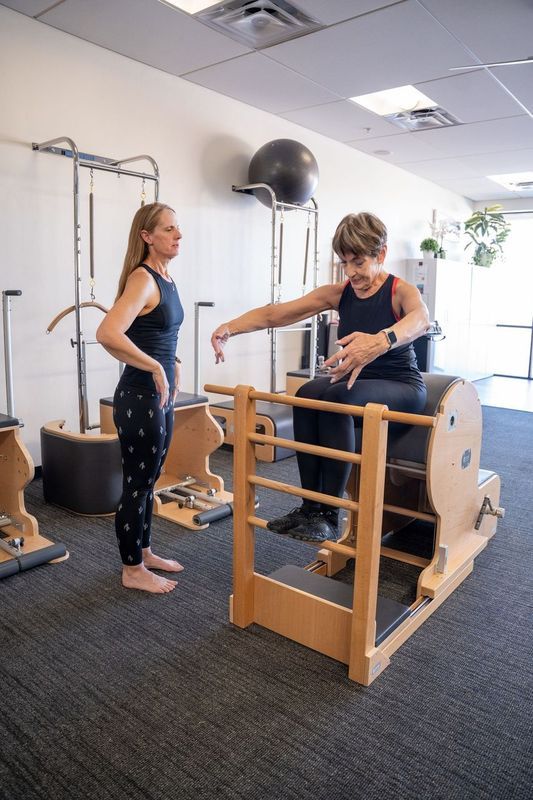
At Swan Pilates, chronological age is part of the information we have about a person. But it doesn't tell us what that person's body is capable of.
That's why we observe, teach, and assess the individual rather than assume their capabilities from the number of years they've lived.
Pilates gives us opportunities to discover and develop physical capabilities that chronological age alone could never reveal.
I've explored this distinction elsewhere in the Swan Essay Library, particularly in What Does It Mean to Be Capable? and Numbers That Nourish: How Metrics Deepen Motivation, Joyfully.
Numbers and data are foundational to decision-making.
And that is precisely why I'm suggesting that the number we assign to our chronological age deserves to be examined accurately, soberly, and with an eye toward possibility.
A Different Kind of Accounting
What if we looked at chronological age through the lens of a business balance sheet?
We wouldn't record depreciation without also accounting for new assets.
Yet when another birthday arrives, we can be remarkably quick to record another depreciation event, heralding the advance of decrepitude.
What an incomplete accounting.
What about the new assets - the victories?
The successes?
The tangible things we learned?
The inexhaustible capabilities we developed?
What did I discover with awe and wonder?
What did I learn about myself that's worth keeping? And of course, what discoveries were less worthy of sustaining?
What became possible that wasn't possible before?
What surprised me?
And perhaps most interestingly:
What might I do with everything I've accumulated so far?
That last question changes the direction of our attention.
Instead of authorizing a number to define us, we begin recognizing the extraordinary accumulation of life behind it.
And perhaps that's where appreciation belongs on our balance sheet.
Not simply the appreciation of assets, but appreciation for ourselves—for the capabilities we've developed, the experiences we've navigated, and the value we've accumulated through living.
What if, instead of assuming depreciation with every passing year, we began recognizing appreciation?
Life is much too vast to be reduced to digits.
As I explored in Another Year Wiser: Why Aging Isn't the End—It's the Leading Edge, the assumptions we attach to age deserve examination.
I think we can go further.
Perhaps the number behind our names deserves an entirely different interpretation.
Your Success Score isn't a prediction of what remains possible.
It's a recognition of the life you've already participated in—and the countless victories represented by those completed revolutions.
And the lovely thing about a Success Score?
It is real.
Warmly,
Susan
Evidence Behind the Ideas
The Central Recognition
Chronological age records elapsed time. It does not provide a complete account of an adult's psychological development, lived experience, autonomy, or capability.
The Success Score is a philosophical interpretation, not a validated scientific measurement. Each completed revolution represents a history of experiences, decisions, adaptations, and victories that cannot be captured by adding a single number to one's age.
Research Behind the Recognition
Codevelopment of Life Goals and the Big Five Personality Traits Across Adulthood and Old Age
This longitudinal study examined more than 55,000 adults, ages 18–103, over 13 years, investigating how changes in personal goals and personality traits relate to one another.
Why it matters: Chronological age does not fully describe an individual's evolving goals, interests, motivations, or personality. These dimensions can continue changing throughout adult life.
The study does not establish that all changes are improvements or that particular goals necessarily cause personality development.
Toward a Theory of Lifespan Personality Trait Development
Bleidorn reviews research on personality development, examining patterns of stability and change throughout life and the contributions of genetic and environmental influences.
Why it matters: Adult personality is neither entirely fixed nor infinitely changeable. Human development is more complex than a chronological label can capture.
The review does not establish that every individual becomes more capable with age or that all changes are under conscious control.
Suggested Reading
- Buchinger, L., Entringer, T. M., Richter, D., Wagner, G. G., Gerstorf, D., & Bleidorn, W. (2024). Codevelopment of Life Goals and the Big Five Personality Traits Across Adulthood and Old Age .
- Bleidorn, W. (2024). Toward a Theory of Lifespan Personality Trait Development .
Research informs our thinking. Life gives it meaning.