Revolutions have been part of human history for centuries.
They challenge established assumptions, overturn accepted norms, expand possibilities for some, and restrict them for others.
But one thing is certain.
Revolutions bring change.
Throughout this essay series, I've been proposing a revolution of my own.
Not a political, economic, or cultural one.
Rather a revolution in accounting and valuation.
We've questioned why the number we call our age was granted authority over our expectations.
We've proposed that the number might be better understood as a Success Score—a recognition of the extraordinary accumulation of experience represented by every completed revolution around the sun.
We've examined the consequences of treating chronological age as a depreciation schedule, making decisions about ourselves and others based on capabilities we haven't actually examined.
And we've considered Joseph Pilates' remarkable body of work, recognizing that the value of physical development extends beyond the exercises performed to what those developed capabilities make possible throughout life.
Three different inquiries.
One underlying proposition.
What if we've been accounting for Life incorrectly?
The Earth will complete another journey around the sun—hopefully.
And it, and we, will encounter circumstances we cannot predict.
Yet just as in past revolutions, change presents us with something more than uncertainty.
It presents us with choices.
We can continue accepting inherited assumptions.
Or we can examine those assumptions individually for ourselves.
We can question the accounting.
We can recognize the assets we've accumulated.
We can develop new capabilities.
And we can decide which possibilities deserve our attention.
What Becomes Possible When the Accounting Changes?
Consider what happens when we discover that something we've believed for years is incomplete.
At first, nothing external may appear to have changed.
The number behind our name gets another digit.
But the conclusions that once seemed settled have opened for examination.
And with that comes the possibility of new choices.
The very heart of the revolution.
Not by denial.
Not by pretending that every limitation can be overcome.
But by recognizing that the conclusions we've inherited are not the final accounting.
Evolution Is Not Merely the Passage of Time
We've become accustomed to describing human life through a chronological point of reference.
But we know we are not simply moving through time.
We are participating in Life as it unfolds.
And participation changes things.
Consider someone who discovers an interest that didn't exist in their life a year ago.
They begin learning.
They encounter unfamiliar people, ideas, and experiences.
They develop capabilities they had no previous reason to acquire.
And something genuinely new begins to emerge.
Not because another year was added to their age.
Because they participated in creating something that hadn't existed before.
That's the distinction this series is appreciating.
Creation Belongs in the Accounting
Consider how often we measure a life by what has already happened.
The education completed.
The career established.
The responsibilities fulfilled.
The years accumulated.
All of these may represent valuable achievements.
But what about what has not yet been created?
A new relationship.
A different way of working.
A capability developed for an interest we haven't yet discovered.
An idea that becomes a business.
A creative endeavor that didn't exist a year ago.
A new way of participating in our community.
These aren't merely extensions of what came before.
Sometimes they represent something that has never existed in our lives until we bring it into being.
And that changes how we might understand the Success Score.
The revolutions we've completed represent accumulated experience.
But that experience isn't simply a record of the past.
It becomes part of the resources available for creating what comes next.
Our Success Score recognizes what we've lived. It does not place a ceiling on what we may create.
What We Practice at Swan
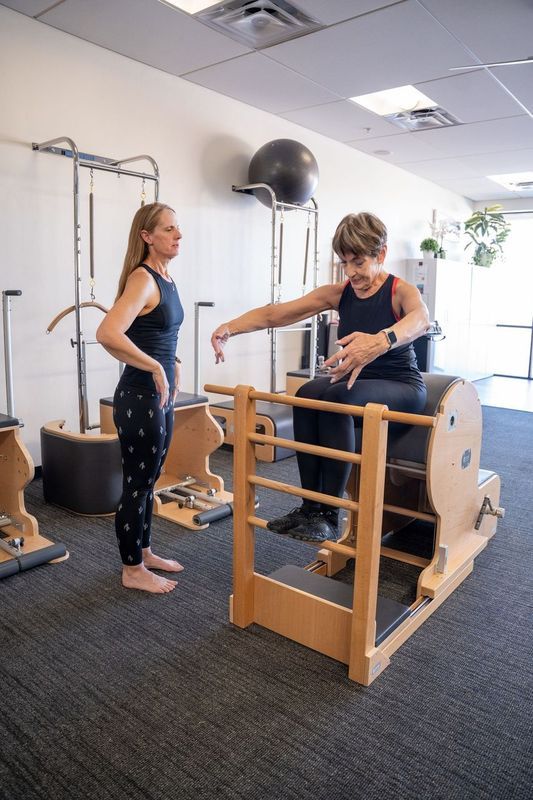
At Swan Pilates, this understanding is central to the way we teach.
We don't know everything our clients will want to do during their next revolution around the sun.
And we don't presume that their chronological ages tell us.
Someone may want to continue dancing.
Someone else may discover an entirely new physical interest.
Another may want greater capability for work, recreation, or ordinary daily activities.
And some people simply enjoy the experience of learning and developing physical skills.
The complete Pilates system gives our teachers opportunities to meet those individuals where they are.
The Reformer, Cadillac, Wunda Chair, Barrels, Spine Corrector, and Mat provide different ways to introduce, support, challenge, and refine movement.
Our teachers use those possibilities to develop capability appropriate to the person.
Not to prepare everyone for an identical future.
But to expand the physical resources each individual may bring into the life they choose to live.
Joseph Pilates understood that his work belonged to something larger than the exercises themselves.
And I believe this is one of the most valuable ways we can honor that vision.
The purpose of developing physical capability is not simply to become better at Pilates. It is to have more capability available for Life.
And when that capability becomes available, something new may become possible.
A pursuit that once seemed beyond reach.
An experience someone hadn't considered.
An activity that becomes part of their life for the first time.
We cannot know in advance what each person will choose to create with their developing capabilities.
And that's precisely why the individual—not the teacher, the apparatus, or the calendar—must remain at the center of the work.
Something New Is Being Born
Perhaps the most important revolution isn't the one that changes the number behind our names.
That will hopefully happen.
The more interesting revolution is the one that changes what we believe that number means.
Imagine a culture in which chronological age remains useful information but no longer serves as a substitute for individual assessment.
Where capabilities are examined rather than presumed.
Where development is recognized throughout adulthood.
Where the accumulated value of experience is appreciated.
And where beginning something new doesn't require an explanation about why someone is the appropriate age to do it.
That would be a different way of accounting for Life.
And perhaps a different way of living it.
Now we have an opportunity to do something with those recognitions.
Not merely adopt a more flattering interpretation of age.
But participate in creating a culture that evaluates people more accurately and leaves room for what they may yet become.
A revolution in valuation can become a revolution in participation.
And participation is where development, discovery, and creation become possible.
The next revolution around the sun is coming.
What it contains remains unknown.
But what if we approach it not as another year to be deducted from our possibilities, but as another opportunity to bring something new into Life?
That's a revolution worth preparing for.
Warmly,
Susan
Evidence Behind the Ideas
The Central Recognition
Chronological age records elapsed time but does not determine an individual's complete developmental trajectory, interests, capabilities, or future choices.
Research on personal goals and psychological needs supports the recognition that adults remain active participants in shaping their lives. Individuals can reconsider their goals, respond to changing circumstances, and benefit from environments that support meaningful choice and competence.
The direction and outcomes of these processes vary. Neither study establishes that development is unlimited or that every individual can achieve every desired outcome.
Research Behind the Recognition
To Let Go for Now or for Good? Goal Shelving and Goal Disengagement Across Adulthood
Psychology and Aging, 40(4), 391–412.
This cross-sectional study examined 973 adults across three age groups: young adults (18–25), middle-aged adults (36–64), and older adults (65+).
The researchers investigated how individuals temporarily set aside goals, permanently discontinue goals, and make decisions about future goal pursuit.
They found no clear age-related differences in the number of goals participants had temporarily shelved or abandoned. Across age groups, people frequently made these decisions to prioritize other goals or respond to resource constraints.
Why it matters: Adults across different stages of life participate in deciding which goals deserve their resources and attention. Chronological age alone does not explain those choices.
The findings support the essay's distinction between accumulated experience and the freedom to reconsider what comes next.
Scientific boundary: This is a cross-sectional study, not evidence tracking the same individuals as they develop new goals over time. It does not establish that all adults have equal opportunities or resources, or that changing goals necessarily produces better outcomes.
Interpersonal Supports for Basic Psychological Needs and Their Relations With Motivation, Well-Being, and Performance: A Meta-Analysis
Journal of Personality and Social Psychology, 127(5), 1012–1037.
This meta-analysis synthesized 4,561 effect sizes from 881 independent samples, representing 443,556 participants.
The researchers examined how interpersonal support for three basic psychological needs—autonomy, competence, and relatedness—relates to motivation, well-being, and performance.
Support for these needs was positively associated with psychological need satisfaction and well-being, and showed small-to-moderate positive associations with performance.
Why it matters: Meaningful choice and the opportunity to develop competence are relevant to human functioning. The conditions in which people participate, learn, and pursue goals can matter alongside their existing capabilities.
This provides a scientific connection to Swan's individualized teaching philosophy, in which teachers support clients' development without prescribing identical goals for everyone.
Scientific boundary: The findings are primarily associational and span multiple settings. They do not prove that autonomy support always improves motor learning, that Swan's particular Pilates model produces these outcomes, or that personal sovereignty guarantees success.
Established Swan Research Connections
Research on the development of personality and life goals across adulthood provides continuity with Essay 1's examination of the evolving individual.
Their work on motor learning, motivation, attention, and autonomy provides an established conceptual connection to the conditions under which physical capabilities may develop.
Contemporary research continues to debate the strength and mechanisms of autonomy-related effects on motor learning. Their theoretical contributions should not be treated as universal experimental findings.
Your Health (1934) and Return to Life Through Contrology (1945) remain historical foundations for Swan's understanding of purposeful physical development.
These shared intellectual sources complement the two contemporary primary references rather than replace them.
Suggested Reading
- Mayer, Z., & Freund, A. M. (2025). To Let Go for Now or for Good? Goal Shelving and Goal Disengagement Across Adulthood .
- Slemp, G. R., Field, J. G., Ryan, R. M., Forner, V. W., Van den Broeck, A., & Lewis, K. J. (2024). Interpersonal Supports for Basic Psychological Needs and Their Relations With Motivation, Well-Being, and Performance: A Meta-Analysis .
Research informs our thinking. Life gives it meaning.