What Is Pilates All About?

Pilates is a method of physical education that uses purposeful movement, controlled resistance, breathing, and skilled instruction to develop strength, coordination, mobility, balance, and physical control.
But that definition, while accurate, leaves out something important.
What are we developing all of those capabilities for?
That question takes us beyond the familiar images of people exercising on Reformers, stretching on Mats, or performing beautifully coordinated movements.
It takes us to the larger purpose of Joseph Pilates' work.
And it may change what we expect from our own Pilates practice.
Joseph Pilates Had a Big Idea
Joseph Hubertus Pilates developed a method he called Contrology.
He wasn't simply inventing exercises.
He was proposing a different approach to physical education, one that recognized the relationship between physical development, mental attention, breathing, coordination, and the demands of everyday life.
His ideas were presented in two books: Your Health (1934) and Return to Life Through Contrology (1945), the latter written with William J. Miller.
Consider that second title.
Return to Life.
Not Complete Your Workout.
Not Burn More Calories.
Not even Develop Stronger Muscles.
Return to Life.
What an extraordinary statement of purpose.
Pilates was interested in developing physical control and a coordinated relationship between body and mind. His ideas challenged aspects of conventional physical education in his era. John Howard Steel, a former student of Joseph Pilates, offers a later historical perspective on the man and his legacy in Caged Lion: Joseph Pilates and His Legacy (2020).
What is the value of physical development if we never consider what that development makes possible in the rest of our lives?
Who Benefits from Pilates?
Who is Pilates for?
Perhaps a more useful question is: What might I benefit from developing?
Consider the people who come to Pilates.
Someone beginning a physical practice for the first time or returning after years away.
A dancer or athlete seeking complementary strength and coordination.
Someone hoping to improve balance, mobility, or confidence in movement.
Or someone who simply enjoys the challenge of learning.
Their interests, starting points, and definitions of progress differ.
Yet each finds something valuable in the Pilates method.
Independent research has investigated Pilates among healthy adults, athletes, and people with health conditions. Several findings are encouraging, though results differ by population, program, and outcome.
Pilates is not for just one kind of person. Its usefulness depends on the person's goals, needs, and the appropriateness of the work.
That's why the individual must remain at the center of the work.
Pilates Is a Method, Not a Machine
For many people today, the word Pilates immediately brings to mind the Reformer.
And with good reason.
The Reformer is a remarkable piece of equipment. Its moving carriage, springs, straps, and adjustable configurations provide opportunities to work with resistance, support, movement control, and coordination.
But the Reformer is not Pilates.
It is one instrument within a much larger system.
Joseph Pilates developed and used an extensive range of apparatus, each offering different conditions for movement and physical development.
The Cadillac, sometimes called the Trapeze Table, offers opportunities for supported movement, resistance, and complex coordination.
The Wunda Chair presents a different relationship with springs, leverage, balance, and body position.
The Barrels and Spine Corrector offer other movement conditions, particularly for exploring spinal articulation, positioning, and control.
And the Mat requires us to organize and move our bodies with relatively little external assistance.
Each has its own possibilities.
More importantly, each gives a knowledgeable teacher different choices.
A movement that is difficult to organize under one set of conditions may become more accessible when the apparatus, support, resistance, or starting position changes.
And once that movement becomes available, the teacher can begin developing it further.
This relationship between movement conditions and capability is explored in the Swan Essay Library's Your Body and Your Brain Need Options.
The apparatus does not define the method. It expands the possibilities for teaching it.
That is why understanding Pilates requires more than learning the names of its exercises or identifying the machines in a studio.
We must understand not only the purpose of the work but the how.
Why Springs? The Engineering Behind the Method
One of Joseph Pilates' most interesting contributions was his use of springs.
Why springs?
Why not simply use weights?
The distinction becomes apparent when we consider how resistance behaves.
With a conventional free weight, gravitational force remains approximately constant, although the demands on the body can change substantially as leverage and joint angles change.
A spring behaves differently.
As a typical extension spring is stretched, the force it produces increases within its normal operating range.
That means resistance can change as the movement progresses.
And because springs can be attached at different positions and angles, they can create different directions of pull and different movement demands.
Depending on the apparatus and setup, springs can provide resistance, assistance, or a combination of both during different portions of an exercise.
Consider what this makes possible for the very different people we met earlier.
The dancer, the athlete, the newcomer, and the person returning to movement need not experience identical demands. A teacher who understands leverage, spring tension, the direction of force, and the individual's movement can select a configuration that serves a particular purpose.
A teacher may use springs to help someone experience a movement they cannot yet organize independently.
The resistance can be changed to create a different challenge.
The attachment point can be altered to change the direction of force.
And the apparatus may allow the same individual to explore a movement under several different conditions.
The spring is not simply a substitute for a weight. It is a way of changing the conditions under which movement occurs.
This is part of the engineering intelligence within Joseph Pilates' apparatus designs.
The Smithsonian's National Museum of American History preserves a Universal Reformer associated with Pilates' studio and documents his March 1927 patent for the apparatus.
Its historical account also describes Pilates' experimentation with springs during World War I. That origin story is widely repeated, although the precise circumstances and motivations behind his earliest experiments are less securely documented than the later patented equipment.
What we can examine directly is the ingenuity of the apparatus itself.
The Reformer, Cadillac, and Wunda Chair don't all create identical movement experiences simply because they use springs.
Their configurations, supports, moving components, and relationships to gravity differ.
And those differences give a knowledgeable teacher choices.
The teacher can use the apparatus to introduce, support, challenge, and progressively develop movement.
But springs alone don't make an exercise intelligent.
The value comes from understanding what the springs are doing, what the individual is experiencing, and why a particular configuration has been selected.
Pilates' apparatus demonstrates a sophisticated practical use of movement mechanics. Skilled Teachers must understand those mechanics to use the available choices intelligently. Joseph Pilates provided possibilities; teaching makes those possibilities useful to individuals.
How Does Pilates Produce Change?
Physical development doesn’t occur simply because an exercise has been completed.
The body responds to the demands placed upon it.
Muscles adapt to appropriate resistance. Balance develops through progressively challenging movement conditions. Coordination improves through practice and feedback, while mobility may improve through movement across appropriate ranges.
But different adaptations require different demands.
An exercise that develops coordination may not provide sufficient resistance to develop substantial muscular strength. Improving flexibility doesn’t necessarily improve balance. And proficiency in a Pilates exercise doesn’t automatically transfer to every activity outside the studio.
The benefit isn’t contained in the name of the exercise. It emerges from what the individual actually develops through practicing it.
That’s why exercise selection, progression, and skilled teaching matter.
What Does Pilates Actually Develop?
Pilates develops opportunities for strength, mobility, coordination, balance, muscular endurance, and greater control of movement.
But these aren’t separate departments of the human body.
A Pilates exercise may require you to coordinate multiple joints, regulate muscular effort, process sensory information, and adjust movement in response to changing resistance.
The nervous system is participating.
The muscular system is participating.
The sensory systems are participating.
And you’re learning to organize them together.
But the value of these capabilities isn’t confined to the exercise itself.
Improved balance may become useful when navigating uneven ground or participating in an activity you enjoy.
Developed strength may become available when you lift, carry, climb, dance, or pursue a demanding recreational activity.
The exercise is the practice. The developed capability is the asset.
And what that capability makes possible is more valuable than the exercise itself.
As I've explored in Physical Capacity Often Changes Before Appearance Does, the significance of physical capacity frequently becomes apparent in the ordinary activities of daily life.
What Does Independent Research Tell Us?
Pilates has attracted research interest beyond its own profession—from physical conditioning and rehabilitation to sport, cognition, and well-being.
The findings offer several useful perspectives.
Strength, Flexibility, and Balance
Pilates can provide muscular resistance, challenge balance, and develop movement control.
In 2026, Čedomir Bajčetić and colleagues published a systematic review and meta-analysis examining Pilates programs and physical fitness in adult women.
Across 12 studies involving approximately 540 women, the researchers found pooled improvements in flexibility and selected body-composition measures.
Pilates can contribute to fitness, and the demands of the particular program matter.
Rehabilitation and Back Pain
In 2015, Tiê Parma Yamato and colleagues published a Cochrane systematic review examining Pilates for chronic nonspecific low-back pain.
Across 10 trials involving 510 people, the researchers found improvements in pain and disability compared with minimal intervention, particularly in the short term.
Because back pain has different causes, some people need medical assessment or rehabilitation expertise alongside exercise.
Dance and Athletic Performance
Dancers and athletes rely on strength, mobility, balance, and coordination—qualities that Pilates can help them practice.
In 2025, Osman Yılmaz, Turgut Kaplan, and Ladislav Batalik published a randomized study examining Mat and Reformer Pilates training in soccer players.
The study involved 30 young male soccer players.
The researchers reported improvements in selected physical and technical measures, with some differences between Mat and Reformer training.
The study does not establish benefits for every sport. Sport-specific skills still require sport-specific practice, while Pilates may provide complementary physical conditioning.
The Brain, Attention, and Well-Being
Pilates involves more than mechanical movement.
A major 2025 umbrella review led by Ben Singh examined the effects of exercise on cognitive functioning.
It synthesized 133 systematic reviews covering more than 258,000 participants.
Exercise interventions were associated with improvements in general cognition, memory, and executive function. To be accurate, this is evidence about exercise broadly, not Pilates alone.
In 2026, Ioannis Tsartsapakis, Aglaia Zafeiroudi, and Charilaos Kouthouris published a systematic review and meta-analysis examining Pilates-based exercise, mental health, psychological well-being, and quality of life.
The review included 32 trials and 1,264 participants. Some outcomes, including aspects of quality of life and self-esteem, were encouraging.
Together, these findings invite us to appreciate physical activity within a broader understanding of human functioning. Training engages our biology, neurology, and psychology together a synergistic whole.
The Teacher Is Part of the Method
There is another dimension of Pilates that deserves specific attention.
Teaching.
Two people can perform an exercise that looks remarkably similar while experiencing very different physical demands.
One may find the movement straightforward.
The other may be working at the edge of their available coordination, strength, or understanding.
The exercise name is the same.
The movement may look similar.
But the teaching requirements are different.
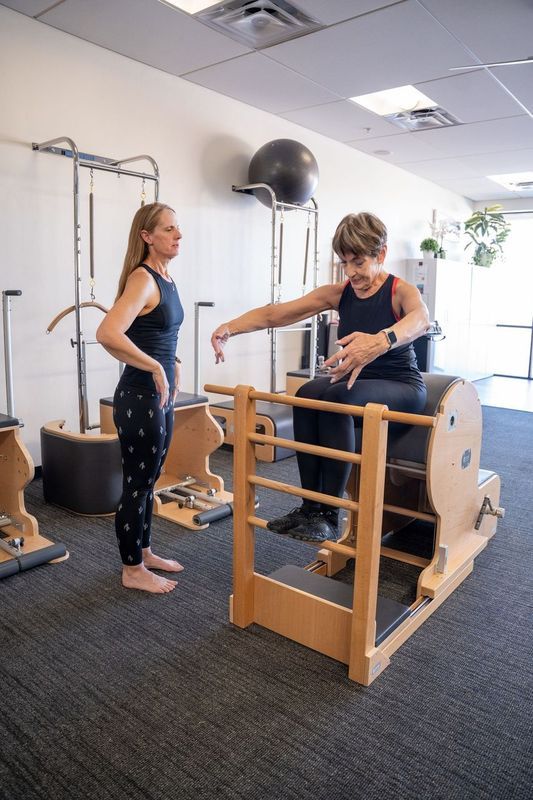
A skilled Pilates teacher observes what is happening, considers the individual's experience and goals, and makes decisions about how the work should proceed.
Perhaps the resistance needs to change.
Perhaps the person would benefit from a different apparatus.
Perhaps a smaller movement would reveal something important.
Perhaps the exercise is no longer sufficiently challenging.
Or perhaps the most useful choice is to stop, reconsider, and approach the task differently.
This is also the subject of our Swan Library essay, We Are More Changeable Than We Think, which examines how changing the conditions of movement can reveal capabilities we hadn't previously recognized.
There is an established scientific framework relevant to these teaching decisions.
In 2016, motor-learning researchers Gabriele Wulf and Rebecca Lewthwaite published their OPTIMAL theory of motor learning, examining how attention, motivation, and practice conditions may influence motor performance and learning.
Their work considers the importance of factors such as expectations for success, autonomy, and attentional focus.
It helps explain why learning conditions deserve attention alongside the movements being practiced.
The theory does not prove that one particular Pilates teaching style is universally superior.
But it reinforces a valuable principle.
Teaching is not simply telling someone which exercise comes next.
It involves creating conditions in which the individual can learn and develop.
And that is a craft.
What Does This Look Like at Swan Pilates?
At Swan Pilates in Oro Valley, Arizona, Joseph Pilates' comprehensive method becomes a practice developed around you.
Whether you're beginning Pilates for the first time, returning after years away, or bringing a lifetime of movement experience, you arrive with capabilities, interests, and possibilities that are uniquely yours.
Your age doesn't determine what we teach you. Neither does your experience, your appearance, or the exercise someone else happens to be doing.
Your teacher takes the time to discover what you're capable of, understand what you want to develop, and determine how to help you progress.
That's why Swan is equipped with the complete Pilates apparatus system.
Your teacher can choose among the Reformer, Cadillac, Wunda Chair, Ladder Barrel, Arm Chair, Pedi-i-Pull, Spine Corrector, and Mat, selecting the conditions that best serve your development.
Perhaps a spring configuration makes a movement more accessible.
Perhaps a different apparatus provides a challenge you're ready to explore.
Perhaps a change in resistance or positioning reveals a capability neither of you had previously recognized.
The equipment provides possibilities. Your teacher's knowledge makes those possibilities available to you.
Your experience with us is shaped by Teachers who have invested substantially in learning their craft.
Swan hosts teacher education programs from BASI Pilates (Body Arts and Science International), an internationally recognized leader in comprehensive Pilates education with more than 30 years dedicated solely to Pilates education.
That depth of educational experience matters. A lot.
Swan Pilates' association with BASI Pilates creates a Teacher Career Ladder through which our BASI-certified Teachers can pursue the qualifications and experience necessary to become BASI Faculty. This opens opportunities to teach nationally and internationally through BASI while maintaining Swan as their home studio. BASI determines Faculty selection and teaching assignments.
Imagine what that means for your Pilates practice.
Your teacher can continue developing expertise, gaining experience, and bringing new perspectives back to the studio where you practice.
You benefit from Teachers whose careers continue to grow—not simply from instructors who have completed a certification.
That's the purpose behind Swan's investment in teacher development: to create a meaningful professional future for our Teachers while continually expanding the knowledge and experience available to you.
Your Practice, Your Way
You can participate at Swan through three teaching formats.
In a Private session, you work individually with one teacher.
In a Duet, you and a person of your choosing share a teacher.
In a Small Group Quartet, you practice with no more than three other clients and one teacher.
Whichever format you choose, the purpose remains the same: to support your development through thoughtful Pilates teaching.
You can explore Swan's services, learn about our Teachers, or review appointments and classes.
And what might that development make possible?
Perhaps greater capability for the activities you already love.
Perhaps the confidence to investigate something unfamiliar.
Perhaps a more rewarding experience of movement itself.
Your Pilates practice isn't about becoming better at someone else's exercises. It's about discovering and developing what becomes possible for you.
So, What Is Pilates All About?
Pilates is about developing physical capability through purposeful movement and practice.
Its applications may extend from general conditioning to dance, sport, and some rehabilitation settings.
Its value cannot be determined simply by counting exercises, measuring perspiration, or identifying the apparatus being used.
Joseph Pilates gave us a remarkably comprehensive method.
Contemporary science gives us opportunities to investigate its applications and limitations.
Skilled Teachers bring the method to individuals.
And individuals bring their own interests, experiences, and possibilities to the practice.
At Swan, we believe the most interesting question isn't simply whether someone can perform a Pilates exercise.
It's what that person may become capable of through the practice—and what they might choose to do with that capability.
Because Pilates was never intended to exist only inside a studio.
It was intended to serve Life.
Warmly,
Susan
Evidence Behind the Ideas
The Central Recognition
Pilates is a comprehensive method of physical education that combines purposeful movement, resistance, coordination, breathing, and attention.
Joseph Pilates developed a system of Mat exercises and specialized apparatus intended to support physical control and coordinated development of body and mind.
Contemporary research has investigated Pilates across physical conditioning, rehabilitation, athletic preparation, and psychological well-being. Findings support benefits in selected areas, although results vary according to the population, program, training demands, and outcomes measured.
The central proposition of this article is that Pilates' value extends beyond performing exercises to the physical capabilities those exercises may develop and what those capabilities make possible in life.
That proposition reflects Susan Swan's interpretation of Joseph Pilates' work, informed by her experience teaching the method and by contemporary research.
Historical Foundations — Joseph Pilates and Contrology
Joseph H. Pilates (1934)
Your Health
Pilates' early presentation of his ideas about physical health, physical education, and the development of bodily capability.
Joseph H. Pilates and William J. Miller (1945)
Return to Life Through Contrology
Presents Pilates' philosophy of coordinated physical and mental development and his original sequence of 34 Mat exercises.
These works establish Pilates' own perspective. They are historical primary sources, not modern controlled scientific studies.
John Howard Steel (2020)
Caged Lion: Joseph Pilates and His Legacy
Steel, a former student of Joseph Pilates, provides a historical account of the man, his teaching, and the development of his legacy.
Historical Engineering — Why Springs Matter
Smithsonian Institution — National Museum of American History
Pilates Universal Reformer
The Smithsonian preserves a Universal Reformer associated with Joseph Pilates' studio and documents his 1927 patent for exercise apparatus.
This provides historical evidence of Pilates' development of specialized equipment incorporating spring resistance.
Why it matters: The Pilates apparatus system creates different mechanical conditions through variations in resistance, support, body position, leverage, and direction of force.
The ability to alter these conditions gives Teachers choices when introducing, supporting, or challenging movement.
Scientific distinction: Within their operating range, typical extension springs increase force as they are stretched. The resistance experienced by a person also depends on the apparatus configuration, leverage, movement direction, and interaction with gravity.
Spring resistance is not inherently superior to free weights or other resistance systems. Its significance within Pilates lies in how it is incorporated into the apparatus and applied through teaching.
Historical qualification: Accounts of Pilates experimenting with springs attached to hospital beds during World War I are widely repeated. The precise circumstances of those early experiments are less securely documented than his later patented equipment.
Primary historical resource: Smithsonian — Pilates Universal Reformer
Independent Scientific Research
Physical fitness, strength, flexibility, and balance
Čedomir Bajčetić and colleagues (2026)
Effects of Pilates Programs on Body Composition, Flexibility, Muscular Strength, Balance, Functional Performance and Respiratory Function in Adult Women: A Systematic Review and Meta-Analysis
Sports, 14(9), 407.
This systematic review and meta-analysis examined 12 studies involving approximately 540 adult women.
The researchers reported statistically significant pooled improvements in flexibility and selected body-composition measures. Some individual studies also reported improvements in strength, balance, endurance, or functional performance.
However, pooled findings did not establish improvements across every outcome, including certain strength and lean-body-mass measures.
Why it matters: Pilates can contribute to physical fitness, but its effects depend on the actual training demands and the individuals participating.
Scientific boundary: The findings concern adult women and cannot automatically be generalized to every population or Pilates program. The review does not establish that full-apparatus instruction is superior to Mat or Reformer-only training.
Rehabilitation and low-back pain
Tiê Parma Yamato and colleagues (2015)
Pilates for Low Back Pain
Cochrane Database of Systematic Reviews, CD010265.
This systematic review examined 10 randomized controlled trials involving 510 participants with chronic nonspecific low-back pain.
The researchers found low-to-moderate-quality evidence that Pilates may improve pain and disability compared with minimal intervention, particularly in the short term.
They did not establish that Pilates was consistently superior to other exercise programs.
Why it matters: Pilates has a recognized place in scientific investigations of exercise for low-back pain.
Scientific boundary: The findings do not establish Pilates as a universal treatment or eliminate the need for appropriate medical assessment and rehabilitation expertise.
Athletic performance
Osman Yılmaz, Turgut Kaplan & Ladislav Batalik (2025)
Randomised Controlled Study on the Effects of Pilates Exercises in Soccer: Comparing Mat and Reformer Methods on Physical and Technical Performance
PLOS ONE, 20(5), e0324129.
This randomized study examined 30 young male soccer players assigned to Mat Pilates, Reformer Pilates, or a control condition.
The researchers reported improvements in selected physical and technical performance measures, with differences between the Pilates interventions for certain outcomes.
Why it matters: Pilates is being investigated as complementary physical conditioning within competitive sport.
Scientific boundary: The small sample and sport-specific setting do not establish that Pilates improves performance in golf, tennis, cycling, dance, or every other athletic discipline.
Exercise, cognition, and brain function
Ben Singh and colleagues (2025)
Effectiveness of Exercise for Improving Cognition, Memory and Executive Function: A Systematic Umbrella Review and Meta-Meta-Analysis
British Journal of Sports Medicine, 59, 866–876.
This umbrella review synthesized 133 systematic reviews, representing 2,724 randomized controlled trials and more than 258,000 participants.
The researchers reported improvements in general cognition, memory, and executive function associated with exercise interventions.
Why it matters: Physical activity can influence aspects of human functioning beyond muscular performance.
Scientific boundary: This is research about exercise broadly. It does not establish that every Pilates program produces the same cognitive effects or that changes in cognition necessarily improve every domain of life. Read the exercise-cognition review
Pilates, psychological well-being, and quality of life
Ioannis Tsartsapakis, Aglaia Zafeiroudi & Charilaos Kouthouris (2026)
Effects of Pilates-Based Exercise on Mental Health, Psychological Well-Being, and Quality of Life
Sports, 14(5), 171.
This systematic review and meta-analysis examined 32 randomized and quasi-experimental trials involving 1,264 participants.
The findings suggested benefits for selected psychosocial outcomes, including aspects of quality of life and self-esteem.
However, the overall unadjusted pooled effect did not reach conventional statistical significance, and results varied across populations and outcomes.
Why it matters: Researchers are investigating Pilates as a practice with potential effects extending beyond physical performance.
Scientific boundary: The findings do not demonstrate universal psychological benefits or establish that Pilates improves every aspect of well-being. Read the Pilates well-being review
Motor learning and the craft of teaching
Gabriele Wulf & Rebecca Lewthwaite (2016)
Optimizing Performance Through Intrinsic Motivation and Attention for Learning: The OPTIMAL Theory of Motor Learning
Psychonomic Bulletin & Review, 23, 1382–1414.
Wulf and Lewthwaite proposed a theoretical framework examining how attentional focus, expectations for success, and autonomy may influence motor performance and learning.
Why it matters: The conditions under which people practice movement can influence learning. Exercise selection, feedback, attention, and opportunities for appropriate choice deserve consideration alongside the movements themselves.
Scientific boundary: OPTIMAL is a motor-learning framework, not a direct test of Swan Pilates or proof that one particular Pilates teaching model is superior.
Suggested Reading
Joseph Pilates and the history of the method
- Pilates, J. H. (1934). Your Health.
- Pilates, J. H., & Miller, W. J. (1945). Return to Life Through Contrology.
- Steel, J. H. (2020). Caged Lion: Joseph Pilates and His Legacy.
- Smithsonian National Museum of American History — Pilates Universal Reformer
Scientific research
- Bajčetić et al. (2026) — Pilates and Physical Fitness
- Yamato et al. (2015) — Pilates for Low Back Pain
- Yılmaz et al. (2025) — Pilates and Soccer Performance
- Singh et al. (2025) — Exercise and Cognition
- Tsartsapakis et al. (2026) — Pilates and Psychological Well-Being
- Wulf & Lewthwaite (2016) — OPTIMAL Theory of Motor Learning
Research informs our thinking. Life gives it meaning.