There are things we know can change.
We learn a new language.
Change careers.
Develop a skill.
Move to another city.
Become interested in something we once ignored.
Become uninterested in something we once thought we couldn't live without.
We expect our ideas to change.
Our preferences.
Our relationships.
Our understanding of ourselves.
And yet, when it comes to the body, we can become strangely certain.
"That's just how I am."
"I've never been flexible."
"My balance is terrible."
"I can't do that."
"This is my bad side."
At some point, an observation becomes a conclusion.
And the conclusion begins masquerading as fact.
What If "Input" Is Viewed as Information?
There is an enormous difference between:
"I can't do this."
and
"I can't do this today."
One is an identity.
The other is information.
Today tells us something useful.
- Where you are.
- What feels easy.
- What feels difficult.
- What your brain and body already know how to solve.
- What they haven't figured out yet.
- What needs support.
- What needs practice.
- What deserves curiosity.
Today matters.
But today doesn't necessarily get the final word.
In Physical Capacity Often Changes Before Appearance Does , we explored how ordinary experiences can tell us something important long before the mirror does.
The hand on the railing.
The extra trip for the groceries.
The pause before standing.
They're not judgments.
They're information.
And information gives us somewhere to begin.
Change Is Often Difficult to See While It's Happening
We tend to imagine change as an event.
Before.
After.
A dramatic moment when something becomes different.
Bodies rarely work that way.
Change can be almost embarrassingly ordinary.
- One more repetition.
- One slightly different experience.
- One moment of better balance.
- One movement that required a little less thought.
One day you realize you reached for something without protecting the shoulder first.
Or stood up without arranging yourself.
Or stepped onto an uneven surface without immediately looking for something to hold.
Nothing announced itself.
No trumpet.
No confetti.
Your brain and body simply knew a little more than they knew before.
Possibility Often Arrives Before Confidence
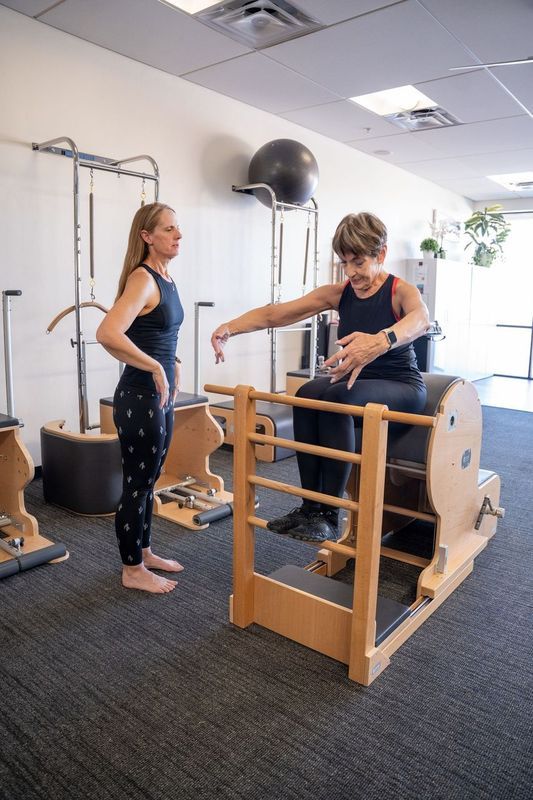
This is one of the things I find most fascinating about teaching.
Sometimes change appears before the person experiencing it believes it.
A teacher sees it.
"Did you notice what you just did?"
No.
They didn't.
Because they were still carrying yesterday's understanding of themselves into today's movement.
Then they try again.
And there it is.
A little evidence.
Not evidence that everything can change.
Evidence that this did.
Sometimes that's enough to reopen a question we had already closed.
In Health Is Not a Cost. It's a Strategic Asset. , we explored the idea that information about the body can be used as feedback rather than judgment.
This is what that can look like in real life.
Something happened.
We noticed.
Now we know something we didn't know before.
We May Know Less Than We Think
Perhaps we should be a little less certain about some of the conclusions we've reached about ourselves.
Not because limits aren't real.
They are.
- Bodies have structure.
- History.
- Injuries.
- Disease.
- Circumstances.
Reality deserves respect.
But respecting reality is different from assuming we already know its boundaries.
That's an important distinction.
"This is difficult."
is information
"This will always be difficult."
is a prediction
"I can't do this today."
is information
"I'll never be able to do this."
is a conclusion
Sometimes the conclusion is correct.
But sometimes...
we simply stopped asking the question.
Curiosity Leaves the Door Open
Certainty says
"I can't."
Curiosity asks
"Can I?"
Certainty says
"That's just how my body works."
Curiosity asks
"What happens if we try something different?"
Certainty closes the conversation.
Curiosity leaves just enough room for new information to arrive.
That's one reason curiosity matters so much at Swan.
We don't need to begin by believing something will change.
We can begin by becoming interested in what happens when we ask a different question.
- Try a different movement.
- Change the conditions.
- Practice something unfamiliar.
- Notice what happens.
Then let the evidence tell us what comes next.
What If It's Changeable?
This may be one of the most useful questions we can ask.
Not:
"How do I fix myself?"
Nothing in that question interests me.
But:
What if it's changeable?
Maybe it is.
Maybe it isn't.
Maybe part of it is.
Maybe the change looks completely different from what we expected.
We don't have to know before we begin.
That's what makes the question powerful.
It doesn't promise an answer.
It creates an opening.
In Wellness Expands Horizons , we explored the possibility of seeing the body not as a project to work on, but as a trusted partner.
Perhaps this is what partnership looks like.
- We pay attention.
- We remain curious.
- We stop deciding the answer before the conversation has taken place.
Because health isn't the destination.
Life is.
Every new capability may become another possibility in the life we get to enjoy.
Perhaps that's the invitation.
Not to assume everything can change.
But to stop assuming it can't.
We may be more changeable than we think.
And there is only one interesting way to find out.
Stay curious.
Evidence Behind the Ideas
The Central Recognition
Human beings are responsive systems.
Our brains, movement strategies, strength, skills, expectations, and behaviors can change through experience.
Change has limits.
But those limits should not be confused with assumptions about what is permanent.
Neuroplasticity
Merzenich's research helped establish the principle of experience-dependent neuroplasticity: neural systems can reorganize in response to experience and learning.
Why It MattersExperience doesn't simply give us memories.
It can change how the nervous system responds to future experience.
Self-Efficacy
Bandura's work on self-efficacy explored how our beliefs about what we can accomplish influence whether we attempt something, persist through difficulty, and respond to setbacks.
Successful experiences can also change those beliefs.
Why It MattersConfidence doesn't always have to come first.
Sometimes evidence comes first...
and confidence follows.
Expectations and Motor Learning
Research incorporated into the OPTIMAL theory of motor learning explores how expectations for success, autonomy, and attentional focus can influence motor performance and learning.
Why It MattersWhat we expect of ourselves isn't separate from the learning experience.
Our expectations can become part of the conditions in which learning occurs.
Psychological Flexibility
Research arising from Acceptance and Commitment Therapy examines psychological flexibility: our capacity to remain responsive to present circumstances while continuing to act in ways aligned with what matters.
Why It MattersChangeability isn't simply physical.
Being able to respond differently when circumstances change is part of human adaptability.
Suggested Reading
Self-Efficacy: The Exercise of Control
Bandura's foundational work on how beliefs about capability influence action, persistence, learning, and behavior.
Explore the book →Optimizing Performance Through Intrinsic Motivation and Attention for Learning: The OPTIMAL Theory of Motor Learning
A major review connecting expectations, autonomy, attentional focus, motivation, and motor learning.
Read the research →Neuroplasticity and Experience-Dependent Change
Merzenich's body of research provides foundational evidence for the nervous system's ability to reorganize in response to experience and learning.
Explore the research →A Liberated Mind
An accessible exploration of psychological flexibility, values, and our capacity to respond differently to experience.
Explore the book →The Brain That Changes Itself
An accessible introduction to neuroplasticity through stories of research, learning, recovery, and neural change.
Explore the book →Research informs our thinking.
Life gives it meaning.