Can Pilates Improve Your Balance?

Your Questions. Our Experience.
Yes, Pilates can help improve balance.
But before we talk about how, let's consider what balance actually is.
You might think of balance as the ability to stand on one foot without wobbling. That's certainly one example.
But what about walking across an uneven surface? Reaching for something on a high shelf? Turning around quickly? Stepping over an obstacle without losing your footing? Moving side to side? Getting up from the floor?
Balance is involved in all of those activities.
And the capabilities required aren't exactly the same.
Balance Training Is Not Optional or Automatic
We sometimes take balance for granted because so much of it happens without our conscious attention.
Until something challenges us.
Perhaps you notice that standing on one foot is more difficult than you expected, or that changing direction requires more concentration.
Those observations may indicate a medical problem but not always. They do tell us something about the demands of the activity and how we're responding to them.
Balance is not a single muscle, a particular exercise, or an ability that improves automatically because we're physically active.
It involves several systems working together.
Your eyes provide information about your surroundings. Your vestibular system, located in the inner ear, helps your brain interpret head movement and orientation. Sensory information from muscles, joints, ligaments, and other tissues contributes to your awareness of where your body is in space.
Your nervous system integrates that information and coordinates the muscular responses needed to maintain or recover your balance.
Quite a remarkable collaboration, isn't it?
And like other movement capabilities, balance responds to training.
What Does Pilates Have to Do With Balance?
Pilates offers opportunities to develop strength, coordination, body awareness, and control of movement.
But here's an important distinction.
Doing Pilates doesn't automatically mean you're training every aspect of balance.
If an exercise is performed lying on a Reformer, it may develop valuable capabilities. But that doesn't necessarily mean it will improve your ability to recover when you unexpectedly lose your footing.
Different activities make different demands on the body.
That's why the way Pilates is taught matters.
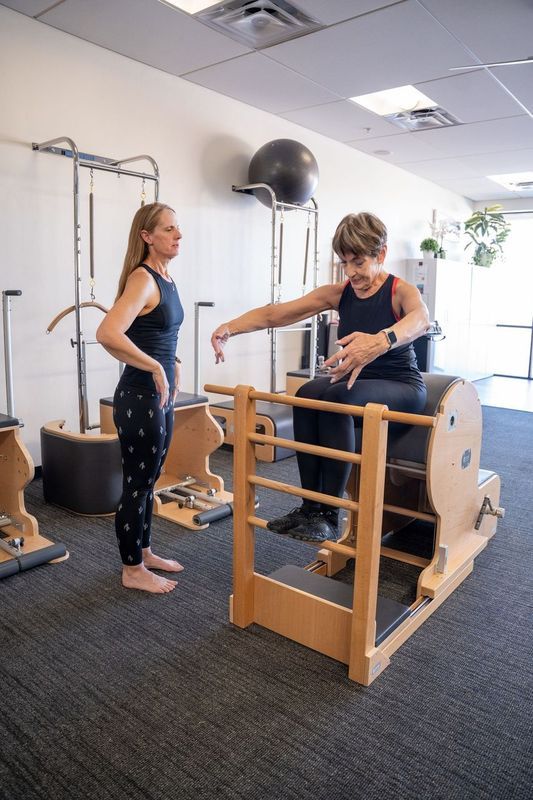
At Swan, our comprehensively trained teachers consider your individual physical capabilities and what you're hoping to develop.
We can introduce exercises that challenge stability, coordinate movement between different parts of the body, and progressively change the demands of an activity.
Sometimes that means narrowing your base of support. Sometimes it means shifting your weight, reaching, changing direction, or coordinating movement while standing.
The challenge should be meaningful, appropriate, and responsive to you.
Not simply difficult for the sake of being difficult.
Standing Still and Moving Through the World
There's a difference between maintaining your balance while standing still and maintaining it while moving.
Researchers describe these as aspects of static and dynamic balance.
Standing on one foot challenges your ability to maintain a position.
Walking, turning, reaching, and changing direction require you to manage balance while your body is moving.
And there's another capability worth considering: how you respond when something unexpected happens.
Perhaps you misjudge a step or encounter an uneven surface.
Your ability to respond involves rapid coordination and balance reactions.
These capabilities are related, but they're not identical. Becoming accomplished at one balance exercise doesn't guarantee that every other balance challenge will become easier.
That's why balance training benefits from variety and progressive challenges that relate to what you actually want to do.
Does the Research Support Pilates for Balance?
Yes, with some important qualifications.
Systematic reviews of Pilates training have reported improvements in certain measures of balance. Much of this research has studied particular populations, including older adults.
Those findings are encouraging, but they don't mean Pilates is uniquely effective for everyone or that improvements in a balance test automatically translate into fewer falls.
And they certainly don't mean that balance is only worth developing at a particular age.
Balance is relevant throughout life.
The more useful question is whether the training challenges the capabilities you want to develop.
That brings us back to the importance of thoughtful instruction.
What If My Balance Is Already a Concern?
First, tell us.
If you're experiencing unexplained dizziness, vertigo, fainting, sudden changes in balance, or repeated falls, those concerns belong in the medical professional's lane.
Sudden loss of balance, especially with weakness, difficulty speaking, or other new neurological symptoms, requires immediate medical attention.
A Pilates teacher cannot determine whether a balance problem originates in the vestibular system, nervous system, medication effects, or another medical condition. Nope, that's not our lane and never will be.
Medical evaluation and clearance are required when your circumstances are outside our scope of practice per Swan's policies.
When Pilates is appropriate, your teacher can work within any established medical guidance and help you explore movement at a level suited to your capabilities.
And there's no prize for attempting a balance challenge before you're ready.
We can use support, adjust the exercise, and progress thoughtfully.
The goal is development, not demonstration though bragging rights are super fun to earn in the process.
What Would Better Balance Make Possible for You?
This is the question I'm most interested in.
Perhaps you want to feel more confident hiking, dancing, playing a sport, or moving through your everyday activities.
Perhaps you'd like to improve your ability to shift your weight, change direction, or coordinate movement while carrying something.
Your goals give balance training a purpose.
At Swan, we don't see balance as a score that defines you.
We see it as a collection of physical capabilities that can be explored, practiced, and developed.
And the interesting thing about developing a capability is that you may discover possibilities you hadn't considered when you began.
That's always worth exploring and bragging about.
Research and Further Reading
- Moreno-Segura et al. (2018). The Effects of the Pilates Training Method on Balance and Falls of Older Adults: A Systematic Review and Meta-Analysis of Randomized Controlled Trials. Journal of Aging and Physical Activity, 26(2), 327–344. DOI: 10.1123/japa.2017-0078.
- Wang, J., et al. (2026). Exercise Modalities for Overall and Domain-Specific Balance Performance in Older Adults: A Systematic Review and Bayesian Network Meta-Analysis. Ageing Research Reviews, 121, 103303. DOI: 10.1016/j.arr.2026.103303.
These studies inform the discussion of Pilates and balance. Findings from particular research populations should not be interpreted as guarantees of improvement for every individual or as evidence that Pilates prevents all falls.