We've all heard it. "Practice makes perfect."
It's one of those phrases that sounds so obviously true we've stopped questioning it.
There's just one problem.
Your body doesn't know what perfect is.
It knows what you repeat.
Repeat something often enough and your nervous system gets very good at recognizing it.
Organizing it.
Anticipating it.
Eventually, what once required thought begins to feel natural.
Practice doesn't necessarily make perfect. Practice makes familiar.
And that distinction matters more than we might imagine.
Your Body Is an Excellent Student
In Your Body Is Always Learning , we explored something remarkable:
Your body has been learning from your life all along.
But here's the delicious complication.
Your body is not particularly judgmental about the curriculum.
It learns what you teach it.
The body isn't misbehaving.
It's learning.
Sometimes brilliantly.
Familiar Feels Easier
There is a reason we return to familiar ways of moving.
Familiarity is efficient.
Your nervous system has already solved the problem.
It knows the route.
So when you reach for something, stand from a chair, climb a stair, or catch your balance, your body doesn't begin from scratch.
It reaches for a solution it already knows.
Most of the time, that's enormously useful.
Imagine having to relearn walking every morning.
But efficiency has an interesting consequence.
The solution your body knows best isn't necessarily the only solution available.
It's simply the one you've practiced most.
Familiar can sound like
"That's just how I move."
Maybe.
Or maybe that's simply the route your body knows best.
Repetition and Learning Are Not the Same Thing
This is where practice becomes interesting.
Repeating something can make us very good at repeating it.
But learning asks for something more.
- Attention.
- Feedback.
- Curiosity.
- Sometimes variation.
- Sometimes challenge.
- Sometimes making a mistake.
- Sometimes discovering there was another way to solve the problem all along.
Watch someone learning to balance and you'll see it immediately.
They wobble.
Correct.
Overshoot.
Try again.
For a moment, it can look less graceful than standing perfectly still.
But the wobble isn't failure. The wobble is information.
The body is discovering where it is.
What worked.
What didn't.
And what to try next.
That's learning.
This Changes What "Good" Practice Looks Like
If repetition alone created better movement, teaching would be easy.
Count to ten.
Do another set.
Repeat tomorrow.
But as we discovered in What If Capability Isn't a Decision? , thoughtful adaptation matters more than perfect performance.
Sometimes learning requires changing the conditions.
- A different spring.
- A different position.
- A different cue.
- A slower movement.
- A smaller range.
- A little less help.
- A little more challenge.
The goal isn't novelty for novelty's sake.
It's to keep the body from confusing:
"This is the way I know."
with
"This is the only way I can."
and eventually
"This is the only way I'll ever be."
That difference is enormous.
A Teacher Can Interrupt Familiar
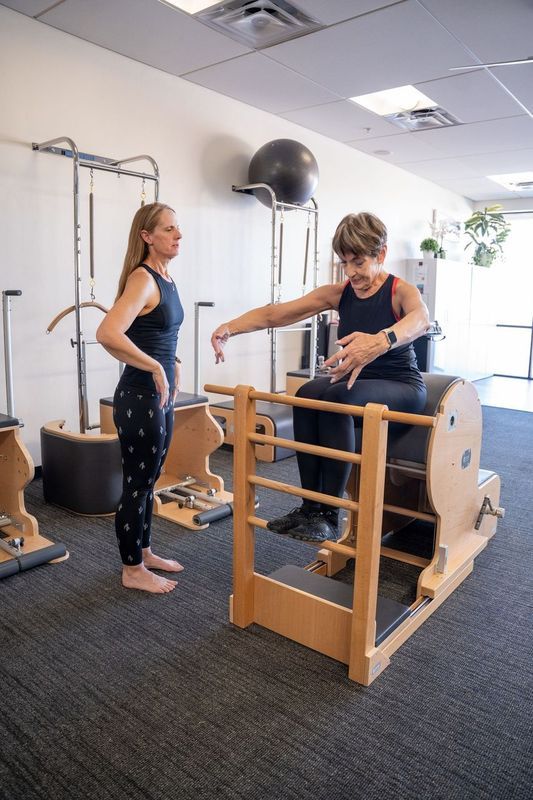
This is another reason the relationship between teacher and client matters so much at Swan.
You can't always see your own "familiar."
Why would you?
It feels normal.
You've rehearsed it hundreds—perhaps thousands—of times.
A teacher watching from the outside may see something you cannot feel from the inside.
- The shoulder that always arrives first.
- The breath you hold before something difficult.
- The side you trust.
- The side you avoid.
- The moment challenge turns into compensation.
And then something wonderful can happen.
A cue.
A pause.
A different setup.
And suddenly:
"Oh."
There it is.
Another possibility.
Not necessarily a better-looking movement.
A more useful one.
As we explored in The Mirror Doesn't Measure Health , what matters isn't simply how movement looks.
Life ultimately asks:
What can I do?
Familiar Is Not Permanent
This may be the most hopeful part.
If repetition helped create familiarity...
new experiences can create new familiarity.
The awkward movement can become easier.
The wobble can become steadier.
The movement you had to think about can eventually happen without thought.
Just as the old pattern once did.
That doesn't happen because practice made you perfect.
It happens because your body learned.
Again.
So perhaps the old saying deserves a small correction.
Practice doesn't make perfect.
Practice makes familiar.
And when what has become familiar no longer serves the life you want to live...
you can practice something new.
Evidence Behind the Ideas
The Central Recognition
Repetition and learning are not the same thing.
Repeated experience makes movements increasingly familiar, while meaningful learning depends on what is practiced, the conditions in which it is practiced, and the information the learner receives along the way.
Familiarity can be useful.
But familiar is not the same as permanent.
Motor Learning and Movement Patterns
A Schema Theory of Discrete Motor Skill Learning
Schmidt's influential work challenged simplistic ideas about storing a separate movement program for every action.
His schema theory proposed that the nervous system develops generalized relationships from movement experiences that can help produce and evaluate future movements.
Why It MattersThe body doesn't simply collect repetitions.
It learns from relationships among what was attempted, what happened, and what the movement felt like.
Learning Requires More Than Repetition
The Role of Deliberate Practice in the Acquisition of Expert Performance
Ericsson and colleagues distinguished ordinary repetition from practice deliberately designed to improve performance.
Their work helped establish an important distinction:
Doing something repeatedly and practicing in a way intended to improve it are not necessarily the same thing.
Why It MattersTen repetitions aren't automatically ten opportunities for meaningful learning.
The quality of attention, challenge, feedback, and adjustment matters.
Attention, Motivation and Learning
OPTIMAL Theory of Motor Learning
Wulf and Lewthwaite brought motivation and attention together in a theory of motor learning.
Their work explores how expectations for success, autonomy, and attentional focus can influence performance and learning.
Why It MattersHow someone experiences practice matters.
The learner is not simply a body receiving instructions.
The Person, the Task and the Environment
Constraints on the Development of Coordination
Newell proposed that movement emerges from the interaction of three broad influences:
- The individual.
- The task.
- The environment.
Change one of those conditions and the movement solution may change too.
Why It MattersSometimes a person doesn't need to "try harder."
Sometimes changing the conditions gives the nervous system a different problem to solve.
Suggested Reading
A Schema Theory of Discrete Motor Skill Learning
Schmidt's foundational 1975 Psychological Review paper introducing schema theory as an approach to understanding motor learning.
Read the research →Optimizing Performance Through Intrinsic Motivation and Attention for Learning: The OPTIMAL Theory of Motor Learning
A major review connecting expectations, autonomy, attentional focus, motivation, and motor learning.
Read the research →The Role of Deliberate Practice in the Acquisition of Expert Performance
The influential 1993 Psychological Review paper distinguishing deliberate efforts to improve performance from ordinary repetition.
Read the research →The Role of Deliberate Practice in Expert Performance: Revisiting Ericsson, Krampe & Tesch-Römer
A useful later reassessment of Ericsson and colleagues' deliberate-practice findings.
It belongs here because following an influential idea also means following what happened when researchers examined it again.
Read the research →Constraints on the Development of Coordination
A foundational chapter proposing that coordination emerges through interactions among the individual, task, and environment.
Explore the research →Research informs our thinking.
Life gives it meaning.