Think about something your body knows how to do without active thought from you.
Walking across the room?
Climbing the stairs?
Reaching for a glass?
Backing your car in or out of the driveway?
Catching yourself when you stumble?
You don't stop to organize every muscle.
You don't calculate every joint angle.
You simply move.
And yet, beneath that seemingly simple movement, your brain and body are coordinating an astonishing number of decisions.
You don't experience any of that complexity.
You experience reaching for the glass.
Somewhere along the way, your body learned how.
And it never stopped learning.
Your Body Has Been Practicing
We tend to think of learning as something that happens in the mind.
We learn a language.
A new skill.
Someone's name.
The way home.
But the body learns too.
- It learns how you sit.
- How you stand.
- How you walk.
- How you reach.
- How you balance.
- How you protect something that once hurt.
- How you compensate when one movement becomes difficult.
- And how to become remarkably efficient at whatever you ask it to do repeatedly.
Some of that learning serves us beautifully.
Some of it once served us beautifully.
And some of it may no longer serve us at all.
That's where things get interesting.
Familiar Can Feel Like Fact
Do something long enough and eventually it stops feeling like something you learned.
It simply feels like you.
"I've always been tight."
"I have terrible balance."
"I'm just not coordinated."
"That's my bad side."
"I've never been very strong."
We say these things as though we're describing permanent features of ourselves.
But sometimes we're describing something much more changeable.
We're describing what our bodies have practiced.
A movement repeated often enough becomes familiar.
A compensation repeated often enough becomes familiar.
Even avoiding something can become familiar.
And familiar has a funny way of disguising itself as permanent.
This is one reason capability can change so gradually that we barely notice it. In Capability Is Stolen by Three Silent Thieves , we explored how inactivity, isolation, and confusion can quietly make the life available to us smaller—even while that smaller life begins to feel familiar.
The Wonderful Part
The body that learned one way of moving can learn something else.
Not instantly.
Not magically.
And not without limits.
But throughout our lives, our nervous systems retain an extraordinary ability to respond to experience.
Think about what that means.
Something you've come to think of as simply you may actually be something your body learned.
And something learned may be capable of being learned differently.
- We can become stronger.
- Steadier.
- More coordinated.
- More confident.
We can learn a movement that once felt impossible.
We can discover that the side we stopped trusting is capable of more.
We can wobble.
Try again.
And wobble a little less.
Sometimes the first evidence of change is almost laughably small.
You reach without thinking.
Catch your balance before fear arrives.
Stand up and realize you didn't need your hands.
And for a moment, something you had quietly accepted about yourself is no longer quite as certain.
Those moments can be easy to miss.
But they're extraordinary.
Because something your body once believed required effort, protection, or hesitation has just become easier.
That isn't positive thinking. It's learning.
And it changes the way we think about capability itself. As we explored in What Does It Mean to Be Capable? , capability isn't the destination. It's what makes the destination possible.
This Knowledge Changes the Role of a Teacher
If the body is always learning, then what we practice matters.
And so does how we're taught.
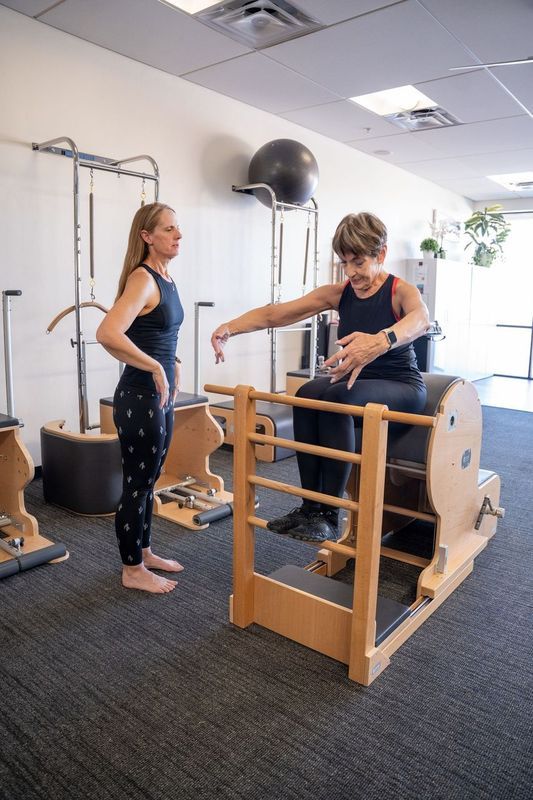
A thoughtful teacher isn't simply counting repetitions.
They're watching.
- What happens when you move?
- Where do you hesitate?
- Where do you compensate?
- What have you become very good at doing?
- And what might your body be ready to learn next?
Sometimes one well-timed cue changes a movement.
Sometimes a different spring changes the information your body receives.
Sometimes slowing down reveals something speed had been hiding.
Sometimes the most important thing a teacher can do is notice.
Because repetition alone doesn't guarantee learning in the direction we want.
And sometimes a teacher sees possibility before the person they're teaching can feel it themselves.
A little more balance.
A little more control.
A movement that suddenly requires less effort.
Those moments matter.
They are evidence that something new is being learned.
That is where teaching becomes something more than exercise instruction. It becomes a relationship with learning.
This Is Why Swan Teaches
At Swan, we're interested in more than whether you can complete an exercise.
We're interested in what your body is learning from it.
Because the goal isn't to become good at Pilates.
It's to become increasingly capable in your life.
- To walk with confidence.
- Reach without hesitation.
- Get onto the floor—and deliberately get back up again.
- Try something you had quietly stopped imagining was possible.
- Perhaps even surprise yourself.
That distinction sits at the heart of The Pilates Body Is Marketing. Capability Is Reality . The purpose of the body isn't simply how it appears. It's what the body makes possible.
Your body has been learning from your life all along.
What would you like to teach it next?
Evidence Behind the Ideas
The Central Recognition
Movement is not simply something the body performs.
It is something the nervous system learns.
And while learning changes throughout life, our capacity to acquire and improve movement skills remains with us.
Motor Learning and Brain Plasticity
Aging, Brain Plasticity, and Motor Learning
Research into motor learning and brain plasticity demonstrates the continued capacity of the nervous system to acquire and improve movement skills through training.
Why It MattersThe body remains capable of learning.
Neuroplasticity
Merzenich's pioneering work helped establish that the brain changes in response to experience.
What we repeatedly experience can influence how neural systems organize and respond.
Why It MattersLearning doesn't simply give us new information.
Experience can change the system doing the learning.
Movement as a Dynamic System
Thelen challenged the idea that movement simply unfolds according to a predetermined program.
Her work showed that movement emerges through an ongoing relationship among the person, task, and environment.
Why It MattersChange the conditions...
and something different may become possible.
The Remarkable Problem of Coordination
Bernstein's foundational work explored how the nervous system organizes the body's enormous number of movement possibilities into coordinated action.
Why It MattersCoordination isn't simply something you either have or don't have.
It is a problem your nervous system is continually learning to solve.
Learning Conditions Matter
Wulf's research explores how attention, feedback, expectations, observation, and learner control can influence motor learning.
Why It MattersPractice matters.
But how we practice matters too.
Suggested Reading
Aging, Brain Plasticity, and Motor Learning
A 2024 review exploring motor learning, neuroplasticity, and the brain.
Read the research →Motor Skill Learning and Performance: A Review of Influential Factors
A review of factors influencing motor learning, including observation, attentional focus, feedback, and learner-controlled practice.
Read the research →A Dynamic Systems Approach to the Development of Cognition and Action
A foundational exploration of development as a dynamic process rather than the unfolding of a fixed program.
Explore the book →Motor Development: A New Synthesis
An influential paper presenting a dynamic-systems perspective on how movement develops and changes.
Read the research →The Brain That Changes Itself
An accessible introduction to neuroplasticity and the brain's capacity for change.
Explore the book →On Dexterity and Its Development
Foundational writings on dexterity, coordination, variability, and the nervous system's ability to solve movement problems.
Research informs our thinking.
Life gives it meaning.