In our previous essay, we considered the cost of getting age wrong.
We also identified another accounting error: reducing Joseph Pilates' remarkable body of work to a single piece of apparatus and a fast-paced workout.
I think that deserves a closer look.
Because something important happens when we measure by metrics that are too narrow, such as how much perspiration we've produced or how many calories we've burned.
Are we overlooking the very assets that make physical development so valuable?
Joseph Pilates Saw Something More
Joseph Pilates called his work Contrology.
His vision was not simply to produce stronger muscles or more flexible bodies.
He was interested in the coordinated development of body and mind, physical control, breathing, and the ability to move through life with greater capability.
Consider the title of his 1945 book.
Return to Life Through Contrology.
Not Complete Your Workout Through Contrology.
Return to Life.
What an extraordinary distinction.
The exercises were not the entire point.
They were a means of developing something that could become available to us beyond the exercise itself.
And perhaps this is where our accounting deserves another examination.
What if we've been measuring the activity while overlooking the value of what it develops? Just as we've measured our time on Earth and overlooked the value of that time.
What Does Physical Development Actually Contribute?
We have many ways of measuring physical performance.
Strength.
Mobility.
Balance.
Coordination.
Endurance.
These measurements matter. They help us recognize what is available, what has changed, and what may need attention.
But imagine someone whose improved balance allows them to safely navigate unfamiliar terrain.
Or someone whose increased strength makes a demanding activity enjoyable rather than exhausting.
Or someone who develops sufficient coordination to participate in an activity they've always wanted to try.
The physical capability is one asset.
What that capability makes possible is another.
And the value may continue beyond the original activity.
Greater physical capacity supports participation in work, relationships, recreation, and life.
The exercise may be completed in an hour. The capability developed may serve us far beyond that time.
That's a significant return on investment.
The Biology Doesn't Stop at the Muscles
Here's where contemporary research becomes especially interesting.
We often speak about physical development as though its benefits remain confined to the body.
But our biological systems do not operate as isolated departments.
Movement involves the nervous system, attention, coordination, sensory information, and the ongoing interaction between body and brain.
Research examining exercise and cognitive function has found measurable benefits in areas including memory and executive functioning.
Think about the implications.
Physical activity contributes not only to how we move, but also to some of the biological conditions supporting how we think, learn, and respond.
This challenges the assumption that the value of physical development can be accounted for entirely through physical performance measures.
When biology changes, the consequences extend beyond the particular capability we set out to develop.
And that brings us back to Joseph Pilates.
Perhaps his larger vision deserves renewed attention—not because modern research proves every claim he made, but because he recognized the importance of considering the person as more than a collection of separate physical parts.
The Value of Having Choices
At Swan Pilates, the complete array of Joseph Pilates machines and apparatus matters.
A Reformer is a wonderful instrument.
But it is not the entire orchestra.
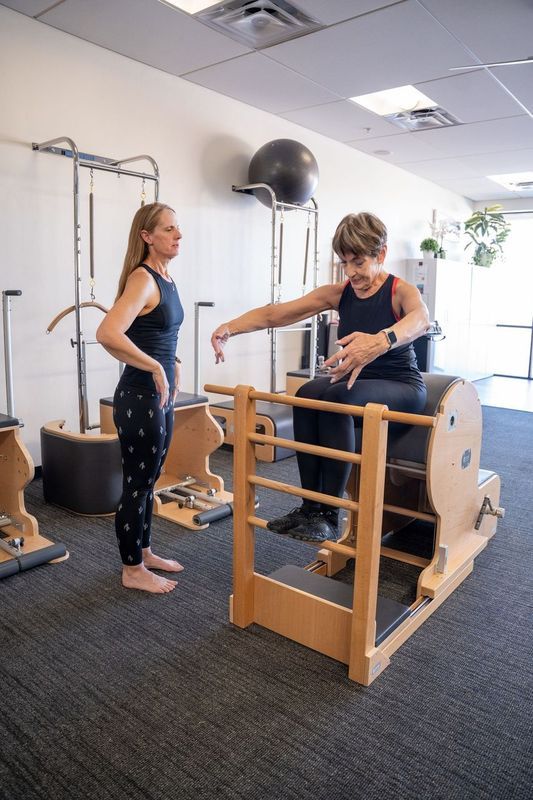
The Cadillac, Wunda Chair, Barrels, Spine Corrector, and Mat offer different possibilities for support, resistance, positioning, challenge, refinement, precision, and personalized development.
And those possibilities matter because human beings are not interchangeable and one size does not fit all, nor should it.
A skilled teacher can observe a movement, recognize its demands, and select an approach appropriate to the individual.
Sometimes changing the apparatus changes the conditions enough for someone to experience a movement more richly.
Sometimes a change in resistance reveals a capability that wasn't apparent before.
Sometimes the most useful development begins with a movement that looks remarkably simple.
And sometimes we discover that what appeared to be a limitation was actually an inappropriate set up.
All of these points connect with our earlier Swan Library exploration, We Are More Changeable Than We Think.
The teacher's work is not simply to dictate movement.
It is to use the Pilates system intelligently to support the development of the person.
The apparatus provides possibilities. The teacher makes choices. The client develops capability.
That's an accounting of Pilates that extends well beyond the number of exercises completed or how fast the Reformer springs are moving.
A More Complete Accounting
Joseph Pilates deserves recognition for the breadth of what he brought forward.
His work invited people to develop physical control, coordination, and a more integrated experience of body and mind.
Today, we have opportunities to investigate those ideas with scientific methods unavailable during much of his lifetime.
And perhaps we can appreciate his work more fully by applying the very accounting principles we've been exploring in this essay series.
When we measure a human life only by the years elapsed, we overlook much of what those years have contributed.
When we measure Pilates only by the exercises performed, we risk overlooking much of what the practice was intended to develop.
And when we reduce Joseph Pilates' complete body of work to a single apparatus or exercise format, we may overlook the choices and possibilities available within the larger system.
In each case, the accounting is incomplete because we've mistaken one measurable part for the value of the whole.
A completed Pilates session is an activity.
A developed capability is an asset.
And what that capability makes possible throughout life may represent a return far greater than the activity alone.
Which brings us back to our Success Score.
Each revolution around the sun gives us opportunities to acquire, use, reconsider, and develop capabilities.
Some of those opportunities begin with physical movement.
But their significance need not end there.
If we measure only the movement, we may miss the development.
And if we measure only the physical development, we may miss what it makes possible in the rest of life.
Perhaps that's the most interesting accounting lesson Joseph Pilates' work has to offer us.
The value of his work deserves to be appreciated in its fullness.
And so does the value of a human life.
What we choose to recognize changes what we understand to be valuable.
And what we understand to be valuable can influence what we choose to develop next.
Warmly,
Susan
Evidence Behind the Ideas
The Central Recognition
Physical activity and structured movement practice can influence multiple aspects of human functioning.
Physical improvements may also change what individuals can participate in, how they experience particular activities, and how they interpret their capabilities.
These effects are not universal, and improvements in one biological domain do not guarantee improvements across all others.
Joseph Pilates' original philosophy and contemporary scientific findings are presented as distinct intellectual contributions.
Research Behind the Recognition
Effectiveness of Exercise for Improving Cognition, Memory and Executive Function: A Systematic Umbrella Review and Meta-Meta-Analysis
British Journal of Sports Medicine, 59, 866–876.
This umbrella review synthesized 133 systematic reviews involving 2,724 randomized controlled trials and approximately 258,000 participants.
The researchers found average improvements in general cognition, memory, and executive function following exercise interventions across diverse populations and ages.
Why it matters: The measurable effects of physical activity can extend beyond physical performance into cognitive functioning.
The review does not establish that every exercise modality produces identical effects or that improved cognition automatically leads to improvements in every area of life.
Effects of Pilates-Based Exercise on Mental Health, Psychological Well-Being, and Quality of Life
Sports, 14(5), 171.
This systematic review and meta-analysis examined 32 randomized and quasi-experimental trials involving 1,264 participants across clinical and nonclinical populations.
The findings suggested benefits for certain psychosocial outcomes, particularly quality of life and self-esteem, although results varied considerably and the unadjusted overall pooled effect was not statistically conclusive.
Why it matters: This research examines whether Pilates-based movement can influence aspects of well-being beyond physical performance.
The evidence is heterogeneous and does not establish that every Pilates program, participant, or psychological outcome benefits equally.
Joseph Pilates — Historical Primary Sources
Your Health
An early presentation of Pilates' ideas concerning physical health, bodily development, and his criticism of prevailing approaches to physical conditioning.
Return to Life Through Contrology
Presents Pilates' philosophy of coordinated physical and mental development, alongside his original Mat exercises.
These historical works establish Pilates' own perspective. They are not modern controlled scientific studies.
Established Swan Research Connections
Their work on motor learning, attention, motivation, and learning conditions provides a useful connection to Swan's earlier essays concerning movement development.
His constraints-based approach to movement coordination offers a conceptual foundation for understanding why performance can change when individual, task, or environmental conditions change.
These authorities remain supporting intellectual connections rather than additional primary research references for this essay.
Suggested Reading
- Singh, B., et al. (2025). Effectiveness of Exercise for Improving Cognition, Memory and Executive Function .
- Effects of Pilates-Based Exercise on Mental Health, Psychological Well-Being, and Quality of Life (2026).
- Pilates, J. H., & Miller, W. J. (1945). Return to Life Through Contrology .
- Pilates, J. H. (1934). Your Health.
Research informs our thinking. Life gives it meaning.