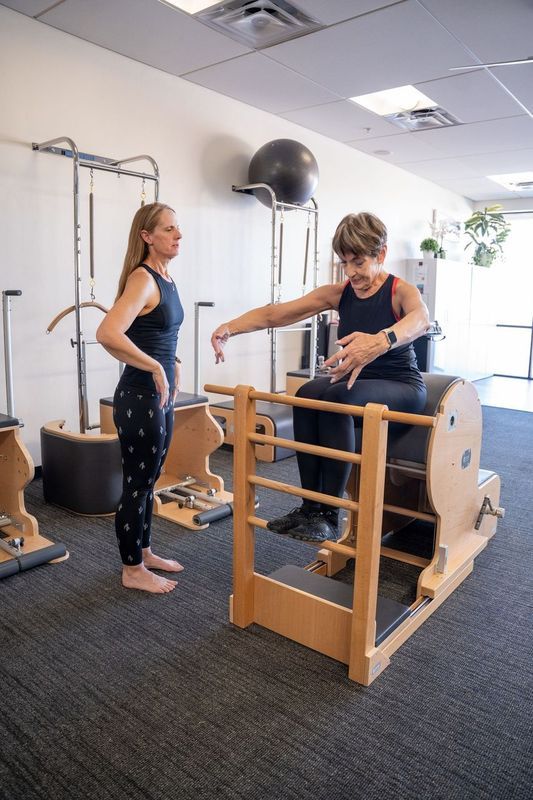
The Body as a Valuable Resource

In almost all fitness and wellness environments, the body is viewed as either a problem to resolve or a mechanical device to sustain. Movement is typically seen as an obligation, a target to attain, or a justification for expenditure. In those models, the body serves as a cost center — reactive management occurs when some form of breakdown has occurred.
Swan operates under a different paradigm.
The body is an asset.
Like other assets, the body's value is influenced by how it is managed.
Movement is the process by which the body is interpreted, centered upon, and enabled to grow in value — to become more valuable.
When people begin to practice Pilates, they commonly assume progress will occur through effort — doing more, being more diligent, spending more time focusing, ignoring their own physical messages. When the method is presented with clarity, the first change is not necessarily in terms of output. Rather, it is in terms of recognition — the body becomes more understandable. Movements and patterns of support, compensation, and inefficiency reveal themselves.
This is not about correcting the body.
It is about learning how to interpret the physical messages generated by the body — learning how to communicate better with your body.
Pilates provides a structured, codified system to facilitate this kind of understanding.
Through precise movement, the body communicates where it is organized, over-loaded and where capacity may be expanded safely. Decisions made during movement become clearer, not due to increased pressure applied to the body, but due to the body becoming more comprehensible.
This is how health increases.
As skills develop, movements become more efficient. Less energy is needed to generate the same or greater work. Instead of competing against each other, stability and mobility start to cooperate. The body becomes more stable, more flexible and more resistant to injury — not through brute force, but through informed responses.
Because these improvements are based on structure (not appearance), they build upon each other.
Pilates, practiced this way, is not about mastering exercises or having perfect posture. It is about developing discrimination — understanding how to identify what is occurring in the body and responding appropriately. This discrimination is what allows the body to be managed with intelligence.
This is why Pilates is fundamental at Swan.
Not because movement is the objective, but because movement is the method of expression through which the body's worth is recognized, preserved and enhanced.