Will Pilates Help My Golf, Tennis, or Cycling?

You already know what your sport asks of you.
You've invested time developing your skills, learning its subtleties, and discovering what makes participation rewarding.
You may have excellent coaches, carefully chosen equipment, and years of experience.
And you probably know that physical capability and technical skill aren't quite the same thing.
Perhaps you've noticed a limitation that wasn't there before. Perhaps there's a level of performance you'd like to reach. Or perhaps you're playing or riding beautifully and simply want to continue doing so for years to come.
What might Pilates contribute?
The answer begins with a distinction worth understanding.
Your sport develops specialized skills. Your physical conditioning develops capabilities that may support those skills.
Strength, mobility, balance, coordination, and endurance are valuable across many activities, but each sport asks you to use them differently.
And that's where the relationship between Pilates and your sport becomes interesting.
Three Sports. Different Demands. A Common Opportunity.
Golf: When Physical Capability Meets a Refined Skill
You know your swing.
You know when it feels effortless and when something isn't quite working.
And you've probably discovered that another lesson, another club, or another practice session doesn't always resolve what you're experiencing.
Sometimes the question isn't technical. It may be physical.
Perhaps you have the skill to produce the swing you want, but maintaining balance, controlling rotation, or sustaining your physical performance through an entire round has become more demanding.
Or perhaps you're playing well and want to preserve the physical capabilities that make the game enjoyable.
Pilates offers an opportunity to investigate those capabilities without turning your session into another golf lesson.
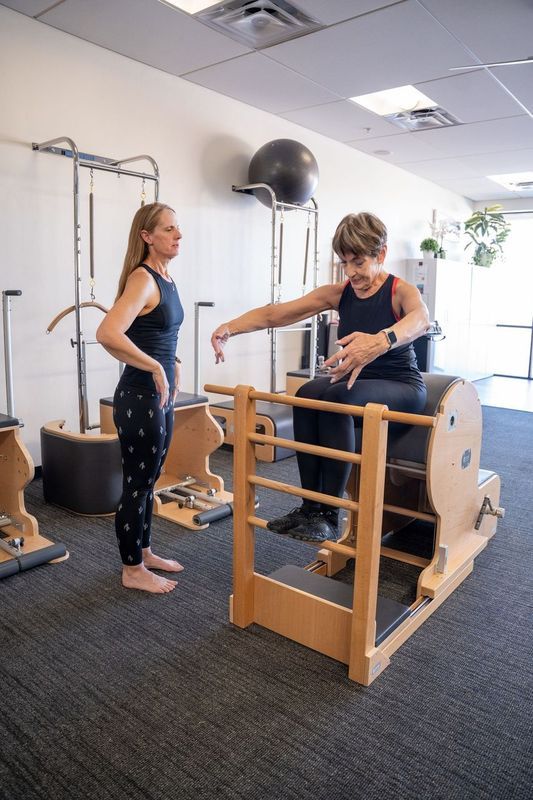
Your teacher can explore how you organize movement, respond to resistance, and coordinate different parts of your body.
A spring configuration may challenge a movement you already perform easily. A different apparatus may reveal a limitation—or a possibility—you hadn't recognized.
Your golf professional develops your game. Your Pilates teacher can help you develop physical capabilities that may support it.
Tennis: Having the Physical Resources to Play Your Game
Whether you play recreationally, compete in tournaments, or travel for matches, you've invested in developing your game.
You may work with a tennis professional, refine your technique, study your opponents, and organize your schedule around opportunities to play.
You know that a successful match involves more than hitting the ball well.
Your ability to reach a difficult shot, recover your position, change direction, and sustain the quality of your play matters.
And you know the difference between having the skill to make a shot and having the physical resources available to execute it.
What if your physical conditioning could give you more to work with on the court?
Pilates offers opportunities to develop strength, balance, mobility, coordination, and movement control outside the demands of a match.
Your teacher can investigate how you organize rotation, manage resistance, and coordinate movement through changing positions.
The work can be selected according to your interests, whether you're preparing for a demanding season, maintaining your competitive level, or simply continuing to enjoy tennis.
Your tennis professional develops the technical and tactical dimensions of your game. Pilates offers another kind of expertise in developing physical capability.
The objective isn't simply to help you play your next match. It's to invest in the capabilities that help keep tennis part of your life.
Cycling: Capability Beyond the Pedals
Cycling offers an extraordinary range of experiences, from long-distance road riding and challenging climbs to organized events and exploring new places.
And there's more to cycling than the ride itself.
Loading and unloading your bicycle, transporting your gear, and preparing for the day's adventure all place demands on your physical capabilities.
You've invested considerable thought in your bicycle, its fit, your training, and the equipment that supports your riding.
You understand the satisfaction of a demanding climb, the rhythm of sustained effort, and the pleasure of covering distance under your own power.
What physical capabilities would you like to bring to your next ride?
Perhaps greater strength for climbing, more comfort and control during long hours in the saddle, or the ability to continue enjoying demanding rides as your interests evolve.
Pilates offers opportunities to develop trunk strength and endurance, hip mobility, coordination, balance, and movement control beyond the repeated movements of pedaling.
Different apparatus and spring configurations allow your teacher to introduce movement challenges that aren't available on the bicycle itself.
This doesn't replace your cycling training, cardiovascular conditioning, or the specialized knowledge of a cycling coach or bicycle-fit professional.
It offers another opportunity to develop the physical resources available to you.
Your bicycle takes you places. Developing your physical capability helps you continue choosing where you want to go.
Why Does Joseph Pilates' Complete Apparatus System Matter?
You may already have a strength-training program, a mobility routine, or a conditioning professional.
So what makes Pilates worth considering alongside them?
One distinction is the range of movement conditions available through Joseph Pilates' comprehensive apparatus system.
The Reformer, Cadillac, Wunda Chair, Barrels, Spine Corrector, and Mat provide different relationships among resistance, assistance, gravity, support, and movement.
Springs are particularly interesting.
Unlike a conventional weight that provides a relatively constant gravitational force, a spring's resistance generally changes as it lengthens. Its effect on your movement also depends on its attachment, direction of pull, and your position.
That means a spring can challenge one part of a movement differently from another.
In some configurations, it can assist you.
In others, it can create considerable resistance.
And changing the apparatus or your position can alter the demands and the results.
For someone with a sophisticated athletic practice, these variations offer opportunities to investigate physical capabilities outside the familiar demands of their sport.
The apparatus doesn't know what you need.
That's why Pilates isn't simply another collection of exercises.
The complete method provides choices. Skilled teaching determines which choices are worth exploring.
And those choices can change as your capabilities develop.
What Does the Research Actually Tell Us?
The research on athletic conditioning offers a useful perspective: physical preparation can contribute to performance, but the effects depend on the training, the athlete, and the demands of the sport.
Golf: Physical Conditioning Can Influence Performance
A 2020 systematic review by Alex Ehlert examined 25 studies investigating physical training interventions for golfers.
The researchers reported that conditioning programs involving strength training, flexibility, plyometrics, and trunk exercises were associated with improvements in measures such as clubhead speed, ball speed, and driving distance.
These findings support the value of physical preparation for golf.
They don't establish that Pilates produces the same results as the conditioning programs studied.
For you, the practical question is whether there are physical capabilities worth developing alongside your technical golf instruction.
Tennis: Performance Requires More Than Strength
Research in tennis conditioning recognizes the importance of repeated acceleration, deceleration, changes of direction, rotational power, and the ability to sustain performance across demanding matches.
Strength and conditioning programs can help develop physical qualities relevant to those demands.
Pilates may offer complementary opportunities to explore mobility, movement control, balance, and coordination.
But improved performance in a Pilates exercise doesn't establish improved tennis performance.
That relationship requires sport-specific evaluation.
Your time on the court remains essential.
Cycling: Different Training Produces Different Adaptations
A systematic review and meta-analysis by Cristian Llanos-Lagos and colleagues, published online in 2025 and in the January 2026 issue of European Journal of Applied Physiology, examined 17 studies involving 262 endurance cyclists.
The researchers found that adding heavy strength training was associated with improvements in cycling efficiency, anaerobic power, and selected performance outcomes.
This supports the broader recognition that physical training outside cycling can contribute to cycling-related outcomes.
Pilates offers a different combination of movement opportunities: strengthening, flexibility, and spinal articulation through varied apparatus and resistance. These qualities may complement cycling conditioning, but the heavy-strength-training review does not establish Pilates-specific effects or improvements in spinal health.
For a cyclist, Pilates may complement a well-developed training program.
What About Pilates Research Itself?
Pilates research has examined outcomes including balance, flexibility, muscular endurance, physical function, and aspects of athletic performance.
Some findings are encouraging.
But studies vary considerably in the populations examined, the exercises used, the length of the interventions, and the outcomes measured.
That makes broad claims about Pilates improving every sport difficult to justify.
The useful question isn't whether a study found that Pilates was beneficial.
It's beneficial for whom, in what way, and under what conditions?
And how closely do those conditions resemble what you're hoping to develop?
Research can inform those questions.
What Does This Look Like at Swan Pilates?
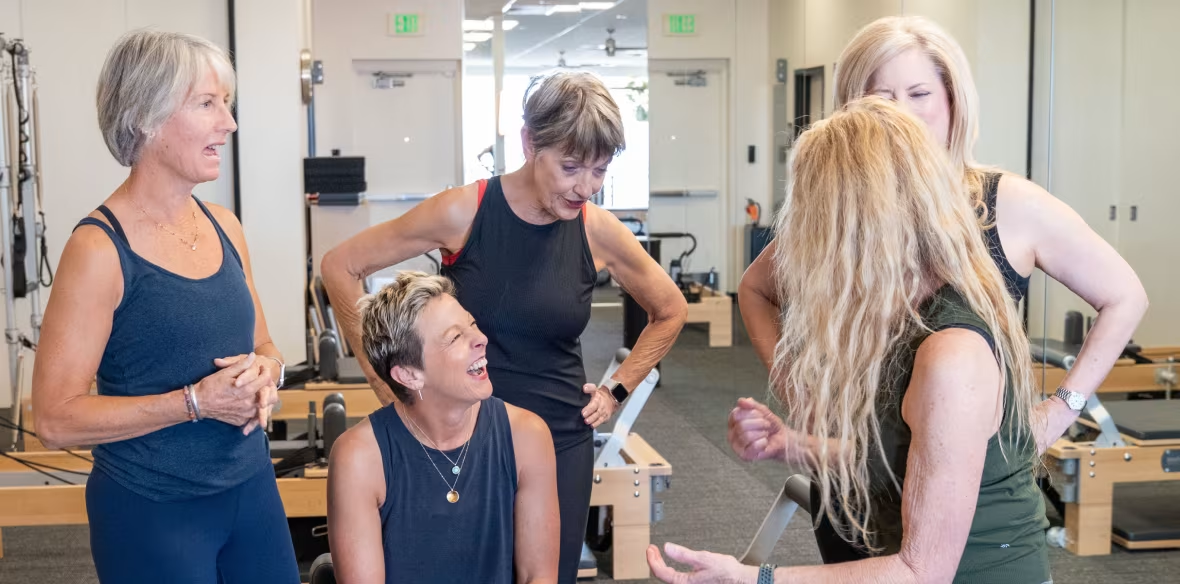
At Swan Pilates in Oro Valley, Arizona, you can bring your athletic experience into a practice developed around your interests, needs, and capabilities.
Your Practice, Your Choice
In a Private session, you work one-to-one with your teacher, with time to explore a particular goal or movement challenge.
In a Duet, you share a teacher with someone you choose—perhaps a spouse, friend, or training partner.
In a Small Group Quartet, you practice with no more than three other clients and one teacher.
You can choose the format that suits you now and change it as your interests develop. These aren’t levels to advance through; they’re different ways to participate.
For more about individual teaching, see When Are Private Pilates Sessions Worth It? For the history and apparatus behind the method, see What Is Pilates All About?
You can also explore Swan’s services, meet our teachers, and review appointments and classes.
The right place to begin is the one that serves what you want to develop.
What Makes the Investment Worthwhile?
Your investment in a sport is rarely limited to the equipment, coaching, or time you spend practicing.
It's also an investment in experiences you value.
The friendships developed over years of playing. The satisfaction of mastering a difficult skill. The places you've traveled. The pleasure of knowing that something challenging is still available to you.
Physical conditioning is one way to continue investing in those experiences.
But the return isn't always measured in a lower handicap, a tournament result, or a faster ride.
Sometimes it's the ability to participate with greater confidence, more physical capacity available for a demanding day or sometimes it's simply being able to say yes to another opportunity to play.
In Swan's Essay Library, Physical Capacity Often Changes Before Appearance Does explores how meaningful physical changes can become evident through what we do, rather than how we look.
Your Body and Your Brain Need Options examines why having more than one movement solution available matters when circumstances change.
And What Does It Mean to Be Capable? asks a question that belongs here, too: what does capability make possible in the life you actually want to live?
Your sport gives you reasons to develop your physical capabilities. What you do with those capabilities gives the investment its meaning.
So, Will Pilates Help Your Golf, Tennis, or Cycling?
Pilates may contribute to the strength, mobility, balance, coordination, and movement control you bring to your sport.
How much it contributes depends on your current capabilities, your goals, the demands of your sport, and the way your Pilates practice is developed.
It won't replace your golf professional, tennis coach, cycling training, or sport-specific practice.
Nor should it.
The value of Pilates is the opportunity to investigate and develop physical capabilities through a comprehensive movement method, with a knowledgeable teacher making decisions appropriate to you.
Perhaps that contributes to better performance.
Perhaps it makes participation more enjoyable.
Or perhaps it helps you continue pursuing a sport that has already given you years of rewarding experiences.
The exercise is the practice. The developed capability is the asset.
And the value of that asset is what it makes possible in your life.
Warmly,
Susan
Evidence Behind the Ideas
The Central Recognition
Physical capability and sport-specific skill are related, but they are not interchangeable.
Physical conditioning may help develop strength, mobility, balance, coordination, endurance, and movement control. Whether those changes translate into measurable athletic performance depends on the demands of the sport and the training undertaken.
Susan Swan's central interpretation is:
Your sport gives you reasons to develop your physical capabilities. What you do with those capabilities gives the investment its meaning.
Historical and Professional Foundations
Joseph H. Pilates (1934) — Your Health.
Joseph H. Pilates and William J. Miller (1945) — Return to Life Through Contrology.
These works establish Pilates' historical philosophy of physical development. They are not scientific demonstrations of improved golf, tennis, or cycling performance.
Independent Scientific Evidence
Golf — Strength and Conditioning
Ehlert, A. (2020). The effects of strength and conditioning interventions on golf performance: A systematic review. Journal of Sports Sciences, 38(23), 2720–2731.
Ehlert reviewed 25 studies examining physical conditioning interventions and golf-performance measures. Many interventions were associated with improvements in clubhead speed, ball speed, and distance, although results varied.
Limitation: The review does not establish that Pilates produces the same effects.
https://doi.org/10.1080/02640414.2020.1796470
Tennis — Physical Conditioning
Fernández-Fernández and colleagues (2026) reviewed tennis match demands and strength-and-conditioning practices, including acceleration, deceleration, multidirectional movement, strength, power, and trunk control.
Limitation: This review concerns tennis conditioning, not evidence that Pilates improves tennis performance.
Fernández-Fernández, J., Colomar, J., & Baiget, E. (2026). Strength and Conditioning Practices in Tennis: A Narrative Review of Contemporary Evidence. International Journal of Sports Physiology and Performance. https://doi.org/10.1123/ijspp.2026-0148
Cycling — Heavy Strength Training
Llanos-Lagos, C., Ramirez-Campillo, R., & Sáez de Villarreal, E. (2026). Heavy strength training effects on physiological determinants of endurance cyclist performance: A systematic review with meta-analysis. European Journal of Applied Physiology, 126, 193–222. Published online July 9, 2025.
The review examined 17 studies involving 262 cyclists. It reported improvements in cycling efficiency, anaerobic power, and selected cycling-performance measures, with low certainty of evidence.
Limitation: The intervention was heavy strength training, not Pilates.
https://doi.org/10.1007/s00421-025-05883-2
Motor Learning and Performance Transfer
Wulf, G., & Lewthwaite, R. (2016). Optimizing performance through intrinsic motivation and attention for learning: The OPTIMAL theory of motor learning. Psychonomic Bulletin & Review, 23, 1382–1414.
This framework explores the importance of attention, motivation, and learning conditions in motor performance and skill acquisition.
Limitation: It does not establish that improvements in Pilates exercises automatically transfer to sporting performance.
https://doi.org/10.3758/s13423-015-0999-9