When Are Private Pilates Sessions Worth It?

Private Pilates instruction costs more than participating in a group class.
So it's reasonable to ask: What makes it worth the additional investment?
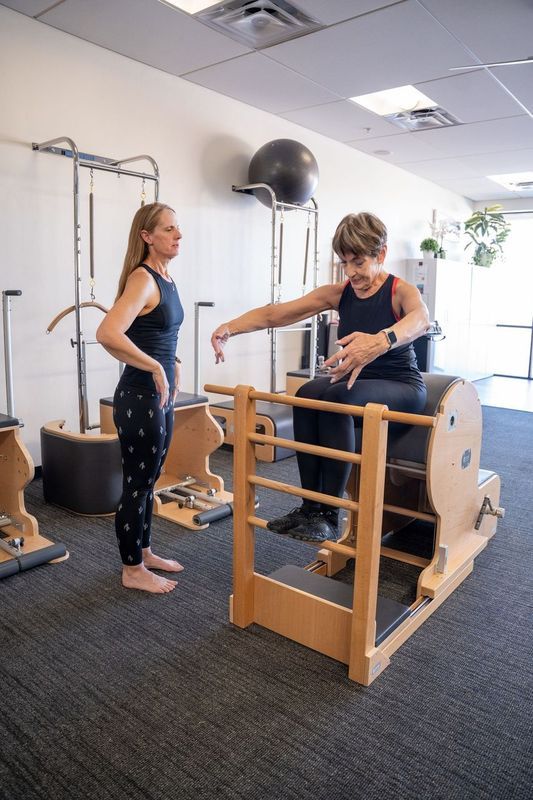
The obvious answer is individual attention. In a Private session, you have a Pilates teacher working exclusively with you.
But attention alone doesn't explain its value.
When Might Private Pilates Be Especially Valuable to You?
There are many reasons to choose Private Pilates sessions.
You may have a particular physical goal, a question about your movement, or something you’d like to develop.
Or you may simply enjoy having an experience devoted entirely to you.
Perhaps you prefer not to exercise in front of other people.
Or perhaps you simply value privacy.
You don't need to explain or justify any preference.
There is value in a dedicated hour that belongs entirely to you.
Days do get filled with responsibilities.
Work demands, family schedules to manage, decisions to make, and people who need something from you seemingly every second of the day
Making your Pilates session the only times when none of that exists.
For an hour, you can set them aside.
You don't have to manage anyone else's experience.
You don't have to make decisions for everyone around you.
You can simply participate in something that belongs to you.
In a Private session, your teacher takes responsibility for guiding the practice while you give your attention to your movement, your breath, your presence with yourself.
Sometimes the value of Private Pilates isn't only what you develop physically. It's having time in your life that is entirely your own.
Are You Experiencing Pain or Physical Discomfort?
Perhaps your back bothers you when you sit for long periods, your shoulders feel uncomfortable during certain activities, or you've begun avoiding movements that used to feel easy.
You may be wondering whether Pilates could help.
Research has found that Pilates can improve pain and function for some people with chronic nonspecific low-back pain. That doesn't mean every kind of pain responds to Pilates or that exercise is appropriate for every condition.
Private instruction gives your teacher time to understand your movement experience, consider the demands of different exercises, and work within any appropriate medical guidance.
The objective isn't to diagnose or treat your pain. It's to explore whether a thoughtfully developed Pilates practice can help you build physical capability.
Are You Recovering from an Injury?
Perhaps you've completed physical therapy and are wondering how to return to regular exercise.
Or perhaps your healthcare professional has recommended that you gradually rebuild strength, mobility, and confidence in movement.
Private instruction allows your teacher to consider your current capabilities and any established restrictions while selecting exercises, apparatus, and resistance.
Your practice can progress as your abilities develop.
The important question isn't simply whether you can perform an exercise.
It's whether that exercise is appropriate and useful to you at this stage of your recovery.
Would You Like to Improve Your Golf, Tennis, Pickleball, or Cycling?
Perhaps you're an experienced athlete who wants to continue developing.
Or you've noticed that strength, balance, mobility, or coordination may be limiting how comfortably or effectively you participate.
Your sport has its own technical demands, and Pilates doesn't replace sport-specific practice or coaching.
But Private instruction provides time to explore physical capabilities that may complement your athletic interests.
Your teacher can consider how resistance, coordination, mobility, and movement control might contribute to the physical resources you bring to your sport.
The objective isn't simply to make you better at Pilates exercises.
It's to develop capabilities you may be able to use in the activities that matter to you.
As I explored in Physical Capacity Often Changes Before Appearance Does, meaningful physical changes often become apparent in everyday activities before they're visible in the mirror.
Are You a Dancer or Performer?
Perhaps you're preparing for a performance, returning after time away, or interested in developing greater strength, coordination, mobility, and control.
Dance asks a great deal of the body.
Private Pilates gives you and your teacher time to explore those physical demands through the complete apparatus system.
You may investigate how different resistance conditions challenge your coordination, how support changes a movement, or where additional strength and control could be useful.
Your dance technique remains the province of your dance training.
Pilates can become a complementary practice that supports your physical development as a dancer.
Has Your Balance or Confidence in Movement Changed?
Perhaps you've become more cautious on uneven ground, feel less confident changing direction, or have begun avoiding activities you previously enjoyed.
You may wonder whether those changes are simply inevitable.
Balance involves several interacting systems, and the reasons for changes can vary.
When exercise is appropriate, Private Pilates can offer supported and progressively challenging movement experiences selected for your current abilities.
Sudden or unexplained balance problems warrant medical evaluation.
But chronological age alone doesn't tell us what you're capable of developing.
Are You Beginning Pilates for the First Time?
You don't need to know the exercises, understand the equipment, or arrive with a particular level of fitness.
Your teacher can introduce the method at a pace that allows you to explore unfamiliar movements, ask questions, and become comfortable with the apparatus.
Private instruction can be especially useful when you want time to understand what you're doing and why.
As I explored in Your Body Is Always Learning, new movement experiences can expand what becomes familiar and available to you.
And as your experience grows, you may discover that a Duet or Small Group Quartet offers the kind of practice you enjoy.
Have You Been Practicing Pilates for Years?
Perhaps you already have a satisfying Pilates practice.
You know the exercises, enjoy your classes, and appreciate the progress you've made.
But you may occasionally want to investigate something more deeply.
A Private session gives you the opportunity to explore a recurring difficulty, reconsider familiar exercises, or introduce new challenges.
As I explore in We Are More Changeable Than We Think, what seems like a fixed limitation may deserve another look.
You don't have to be a beginner to benefit from individual teaching.
And you don't have to abandon the group practice you enjoy to make room for an occasional Private session.
Whatever brings you to Pilates, the question isn't whether your situation fits a particular category.
It's whether having a teacher devote their knowledge, attention, and time specifically to you would make a meaningful difference in what you want to develop.
What Can a Teacher Discover in a Private Session?
One of Joseph Pilates' most interesting contributions was his comprehensive apparatus system.
The Reformer is only one part of it.
The Cadillac, Wunda Chair, Barrels, Spine Corrector, Mat, and other apparatus offer different relationships among resistance, assistance, gravity, support, and movement.
This matters because an exercise isn't defined solely by what it looks like.
Consider a movement that's difficult for you.
Perhaps the challenge is strength.
Perhaps it's coordination.
Perhaps you don't yet understand how to organize the movement.
Those possibilities can look surprisingly similar from the outside.
A knowledgeable teacher can explore them by changing the conditions.
A spring may provide assistance in one configuration and resistance in another.
A different apparatus may make a movement more accessible—or considerably more demanding.
And an exercise that initially seems impossible may become understandable when approached differently.
This relationship between changing movement conditions and developing available solutions is explored in Your Body and Your Brain Need Options.
The apparatus provides choices.
Your teacher's knowledge determines how those choices can best serve you.
Not because a particular machine is scheduled for the hour.
Not because everyone is performing the same sequence.
But because the apparatus, resistance, and movement conditions can be chosen with your development in mind.
The value of the complete system isn’t how much equipment surrounds you. It’s how many thoughtful choices become available to your teacher to help you.
We explored this relationship more fully in What Is Pilates All About?, particularly in the discussion of spring resistance and the complete Pilates method.
The important point here is that Private instruction provides more time to investigate those choices with you.
And that investigation can be as valuable for an experienced practitioner as it is for someone just beginning.
Does Everyone Need Private Pilates?
No.
And I think that answer deserves to be stated plainly.
Private instruction offers a particular teaching opportunity. It isn't automatically better Pilates.
A person can develop strength, mobility, balance, coordination, and substantial movement skill in a well-taught group setting.
A skilled teacher can observe and guide individuals in a group, particularly when the group is small enough to preserve meaningful attention.
Some people also enjoy the energy, companionship, and consistency of practicing alongside others.
Those qualities matter.
In 2026, Marlene Kritz and colleagues published a systematic review and meta-analysis in Nature Human Behaviour, comparing individual and group-based physical-activity interventions.
The researchers examined 71 studies covering physical activity, functional performance, health, and psychosocial outcomes.
They found that both individual and group approaches could be effective, without establishing a consistent overall advantage for individual instruction. Some secondary analyses favored group formats for functional outcomes.
This wasn't a direct comparison of Private Pilates and Swan's four-person Quartets. In fact, many of the individual interventions in the review were home-based programs rather than one-to-one instruction with a teacher.
Still, it offers a useful perspective.
The format alone doesn't determine the value of the practice.
What happens within that format matters.
What Does This Look Like at Swan Pilates?
At Swan Pilates in Oro Valley, Arizona, your practice begins with you—your interests, your capabilities, and what you’d like to develop.
You have access to Joseph Pilates’ comprehensive method, a complete apparatus system, and teachers whose education and experience inform the choices they make with you.
Your teacher can select exercises, adjust resistance, change apparatus, and introduce new challenges according to what would be useful for your development.
The quality of those decisions matters.
Swan’s teachers bring comprehensive professional education to their work. Our relationship with BASI Pilates also supports their continuing career development, including opportunities to pursue BASI Faculty qualifications and teach nationally or internationally while maintaining Swan as their home studio.
Your practice benefits from teachers whose professional knowledge and experience continue to grow.
Your Practice, Your Choice
You can participate at Swan in several ways.
In a Private session, your teacher’s attention is devoted exclusively to you.
In a Duet, you and a person of your choosing share a teacher.
In a Small Group Quartet, you practice with no more than three other clients and one teacher.
You may begin with Private instruction while becoming familiar with the method and apparatus.
Later, you may discover that a Quartet offers the right combination of challenge, guidance, companionship, and consistency.
Or perhaps you prefer sharing your practice with a friend or partner in a Duet.
You can also return to Private instruction whenever you want to explore a particular goal, investigate a movement challenge, or deepen your practice.
These aren’t levels you advance through. They’re choices available to you as your interests and capabilities develop.
And your preferences may change over time.
Another Way to Begin: Your Health Blueprint
Swan also offers Your Health Blueprint, a private, one-to-one assessment and consultation with me.Together, we review your InBody body-composition measurements and consider what they may mean for your physical development, interests, and goals.
Your Health Blueprint is distinct from a Private Pilates teaching session. It provides another opportunity to give your physical development focused attention and make informed choices about what you’d like to explore next.
You can explore Swan’s services, meet our teachers, and review appointments and classes.
The question isn’t whether one teaching format is inherently superior.
It’s which experience would be most valuable to you now.
So, When Are Private Pilates Sessions Worth It?
Private Pilates is worth considering when the additional time, attention, and teaching choices offer meaningful value for you.
Your time is valuable.
So is the opportunity to devote it to something that matters to you.
Perhaps that means developing a physical capability, exploring a new challenge, or simply enjoying an hour in which your own interests come first.
The return on your investment is yours to define.
And the purpose of Private instruction isn't to make you dependent on it.
It's to help you develop a Pilates practice that continues to serve you now and in the long run.
Warmly,
Susan
Evidence Behind the Ideas
The Central Recognition
Private Pilates instruction offers an opportunity for individualized observation, exercise selection, feedback, and progression.
Its value depends on the person, their goals, the teacher's knowledge, and the demands of the practice.
The central proposition of this article is that Private instruction is valuable when the additional teaching attention and choices meaningfully serve the individual's development—not simply because the session is private.
This is Susan Swan's interpretation of the practical value of individualized Pilates teaching.
Individual Versus Group-Based Exercise
Kritz, M., Riddell, H., Olsen, D., Harden, S. M., Burke, S. M., Ntoumanis, N., & Thøgersen-Ntoumani, C. (2026)
Individual versus group-based interventions: A systematic review and meta-analysis of physical activity, functional, psychosocial and health outcomes.
Nature Human Behaviour, 10, 1109–1121.
The researchers analyzed 71 studies comparing individual and group-based physical-activity interventions.
Both formats were potentially effective. The primary analyses did not establish a consistent overall advantage for either format, although some sensitivity analyses favored group interventions for functional outcomes.
Why it matters: The evidence challenges the assumption that individual exercise is inherently superior to group exercise.
Research limitation: Most individual interventions were home-based, often with limited facilitator contact. The review did not directly compare one-to-one Pilates teaching with small, teacher-led Pilates classes.
Read the Kritz systematic review
Pilates Teaching and Professional Standards
The Society for the Pilates Method (2025)
Scopes of Practice Overview.
This professional document addresses the responsibilities of Pilates teachers, including apparatus knowledge, exercise progression, individual needs, and client safety.
It also recognizes the importance of group sizes that permit individual attention and appropriate instruction.
Why it matters: Individual observation, progression, and professional judgment are recognized responsibilities of Pilates teaching, not features exclusive to Private sessions.
Evidence distinction: This is professional guidance, not a clinical trial establishing the effectiveness of a particular teaching format.
Read the Pilates scopes of practice
Motor Learning and Individualized Teaching
Wulf, G., & Lewthwaite, R. (2016)
Optimizing performance through intrinsic motivation and attention for learning: The OPTIMAL theory of motor learning.
Psychonomic Bulletin & Review, 23, 1382–1414.
Wulf and Lewthwaite proposed a framework examining the influence of attentional focus, expectations for success, and autonomy on motor performance and learning.
Why it matters: Teaching decisions concern more than exercise selection. The conditions in which someone learns, practices, and receives feedback can influence movement learning.
Research limitation: The OPTIMAL theory is not a direct comparison of Private and group Pilates instruction.
Read the OPTIMAL theory research
Privacy, Body Image, and Learning Comfort
Sabiston, C. M., Pila, E., Pinsonnault-Bilodeau, G., & Cox, A. E. (2014). Social physique anxiety experiences in physical activity: A comprehensive synthesis of research studies focused on measurement, theory, and predictors and outcomes. International Review of Sport and Exercise Psychology, 7(1), 158–183. https://doi.org/10.1080/1750984X.2014.904392
This synthesis reviewed 126 studies on concerns about appearance evaluation in physical-activity settings. It supports recognizing that social evaluation can shape exercise experiences, without proving that one-to-one Pilates is superior.
Spink, K. S. (1992). Relation of anxiety about social physique to location of participation in physical activity. Perceptual and Motor Skills, 74(3), 1075–1078. https://doi.org/10.2466/pms.1992.74.3c.1075
In a small study of 37 nursing students, higher social physique anxiety was associated with a greater tendency to exercise privately. This observational finding is limited and does not establish causation or Pilates-specific outcomes.
Edmondson, A. (1999). Psychological safety and learning behavior in work teams. Administrative Science Quarterly, 44(2), 350–383. https://doi.org/10.2307/2666999
Edmondson found an association between psychological safety and learning behavior in workplace teams. This offers broader context for the importance of feeling safe to ask questions and make mistakes; it is not evidence that Private Pilates creates psychological safety or improves outcomes.
Personal Time and Recovery from Everyday Demands
Sonnentag, S., & Fritz, C. (2007). The Recovery Experience Questionnaire: Development and validation of a measure for assessing recuperation and unwinding from work. Journal of Occupational Health Psychology, 12(3), 204–221. https://doi.org/10.1037/1076-8998.12.3.204
This research examines recovery experiences, including psychological detachment from work demands. It provides broader context for the value of time away from responsibilities; it does not test Private Pilates or establish a clinical benefit from a Pilates session.
Historical and Professional Foundations
Joseph H. Pilates (1934)
Your Health.
Presents Pilates' early ideas about physical education and health.
Joseph H. Pilates and William J. Miller (1945)
Return to Life Through Contrology.
Presents Pilates' philosophy of coordinated physical and mental development and his original Mat exercises.
These are historical primary sources explaining the method's origins, not controlled scientific evaluations of Private instruction.
Suggested Reading
- Kritz et al. (2026) — Individual Versus Group-Based Exercise
- Society for the Pilates Method (2025) — Scopes of Practice
- Wulf & Lewthwaite (2016) — Motor Learning
- Sabiston et al. (2014) — Social Physique Anxiety
- Spink (1992) — Preference for Private Exercise
- Edmondson (1999) — Psychological Safety and Learning