Pain Is No Joke

Your Questions. Our Experience.
Pain is no joke. It can inform every decision a person makes.
Pain is a communication from the body, and it means something. But pain is complex. It involves the nervous system and doesn't always indicate injury or damage to a particular part of the body.
Medical professionals and Pilates teachers have different roles.
And those professional responsibilities must remain distinct.
Medical professionals evaluate symptoms, diagnose medical conditions, and determine appropriate treatment.
At Swan, our comprehensively trained Pilates teachers work in the wellness and movement education lane. We observe movement, listen to your goals, and help you develop your physical capabilities.
We don't diagnose medical conditions or provide medical treatment and never will.
When pain involves a medical concern, medical evaluation and clearance are required under Swan's policy when the circumstances warrant them. It is key that we know any precautions or limitations established by your healthcare professional.
With your permission, we can work in tandem with your medical professionals, respecting their guidance while providing individualized Pilates instruction.
That's where the two lanes come together—not by crossing professional boundaries, but by working toward your well-being.
So, Can Pilates Help When You're Experiencing Pain?
Yes, it can. But what that help looks like depends on you.
Pain can change how you move. You may begin avoiding certain movements, favoring one side of your body, or becoming reluctant to attempt activities you once enjoyed.
Those responses are understandable. Pain gets our attention, although it doesn't always tell us precisely what is happening in the body.
Once medical concerns have been appropriately evaluated and Pilates participation is suitable, we can begin exploring what movement is available to you.
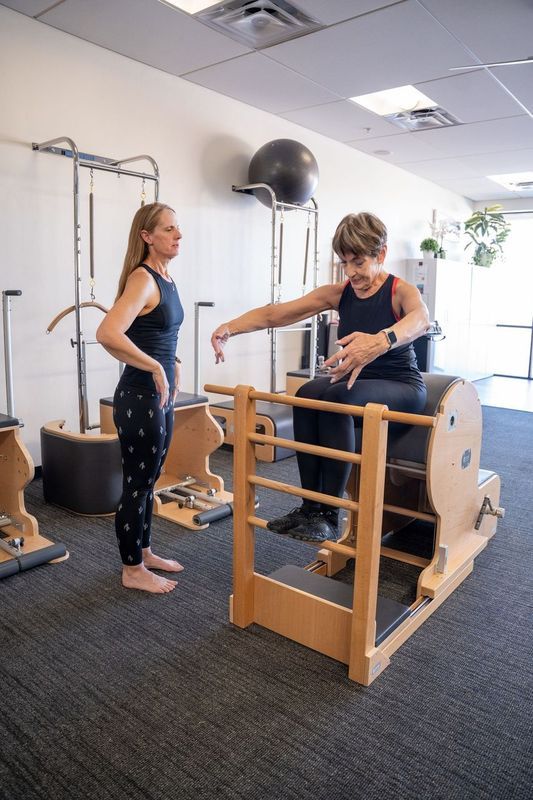
Your teacher observes how you organize movement, how you respond to different exercises, and where adjustments may help you work more comfortably and effectively.
Medical clearance doesn't mean every Pilates exercise is automatically appropriate. Your teacher still needs to observe, listen, adapt, and respond to your experience.
We need to understand the relevant medical information, precautions, and guidance from your healthcare professional so we can help you develop movement skills, strength, coordination, and an understanding of your physical capabilities.
And your experience matters. You're an active participant in the process, not simply someone following instructions.
Where Does It Hurt?
Back, knee, shoulder, and neck pain are among the concerns people bring to conversations about Pilates.
Each deserves its own consideration.
Can Pilates Help With Back Pain?
Back pain can affect nearly everything—sitting, standing, walking, sleeping, and the simple business of getting through a day.
It can also make people hesitant to move.
Fortunately, we have meaningful research supporting exercise as part of the management of persistent, nonspecific low-back pain.
The World Health Organization recommends appropriately selected exercise programs among the options for managing chronic primary low-back pain. Research examining Pilates has found improvements in pain and physical function for some participants.
That's encouraging evidence, not a promise that Pilates will resolve every kind of back pain.
At Swan, we're interested in how you move as a whole person.
How do you coordinate movement through your spine, hips, and pelvis? How do you organize your body when changing positions? What happens when we modify an exercise or change the amount of resistance?
Your teacher can help you explore these questions through Pilates instruction, working within any medical precautions.
The objective is to develop strength, coordination, and movement options that support your goals.
And sometimes discovering that you can move more comfortably than you expected is a meaningful beginning.
Can Pilates Help With Knee Pain?
Think about how often your knees participate in daily life.
Getting out of a chair. Climbing stairs. Walking across a parking lot. Gardening. Dancing.
Your knees are busy!
But knee pain doesn't tell us, by itself, what's causing the problem.
Once relevant medical concerns have been addressed, Pilates may offer opportunities to develop the movement capabilities involved in everyday activities.
The knee doesn't work in isolation. Movement through the torso, hips, legs, ankles, and feet contributes to how we stand, walk, bend, and transfer weight.
The knee's primary movements are bending and straightening. It also bears weight and contributes to stability. How we coordinate the rest of the body influences how forces are managed during movement.
In Pilates, we develop the coordination that allows the whole body to participate in managing movement and distributing load.
We can explore these relationships while adjusting positions, resistance, and movement demands.
At Swan, we aren't talking to the knee in isolation. We're teaching movement.
And the question becomes: What can you learn and develop that helps you participate more confidently in the activities that matter to you, including bending your knees?
Can Pilates Help With Shoulder Pain?
Shoulders give us a remarkable range of movement.
Reaching overhead, lifting, carrying, dressing, and countless everyday activities depend on coordinated movement involving the arms, shoulder blades, and trunk.
When shoulder pain enters the picture, even ordinary activities can become frustrating.
The source of shoulder pain matters. Medical professionals are trained to evaluate the complexity of the shoulder.
The shoulder complex allows considerable mobility through the coordinated movement of several joints and surrounding structures. That mobility also requires thoughtful coordination and control.
A recent injury, persistent limitation, or unexplained symptoms may require medical assessment and specific precautions before Pilates is appropriate.
Once participation is suitable, your teacher can explore how you coordinate movement through your arms, shoulder blades, and upper body.
Perhaps an exercise needs a different position, a smaller range of movement, or a change in resistance.
There's no "push through pain to demonstrate effort." Such an attitude is counterproductive.
Rather, movement gives us an opportunity to develop capabilities appropriate to your body, not to apply a standard solution or a one-size-fits-all approach.
Shoulders are complex and deserve individualized attention.
Can Pilates Help With Neck Pain?
Neck pain can influence how you turn your head, work at a computer, drive, sleep, and move through your day.
People often arrive at Swan with ideas that there is something wrong with their posture, and yes, posture is a tremendously important consideration.
But posture alone doesn't explain every experience of neck pain.
The cervical spine supports the head while allowing considerable movement. Its anatomy, surrounding muscles, nerves, and other structures deserve thoughtful attention, particularly when someone is experiencing pain or restricted movement.
Medical assessment is important when symptoms and circumstances warrant it.
The important question is how to develop movement appropriately for the individual.
Your Pilates teacher may explore the relationship between your head, neck, shoulders, upper back, mid-back, abdominals, pelvic floor, and even your feet and legs—all while paying attention to how you respond.
The neck is part of a moving person, not an isolated problem to be fixed.
And that's how we approach the teaching.
What Should I Tell My Pilates Teacher About My Pain?
Quite a bit, actually. This is one situation where "more is more."
Tell us what you've experienced, what your healthcare professional has advised, and whether there are movements or activities you've been asked to avoid.
Tell us what you're comfortable attempting and what concerns you.
And tell us what you'd like to be able to do.
Perhaps you want to return to gardening, enjoy a walk, lift your grandchildren, travel more comfortably, or simply feel more capable in everyday movement.
Your goals help give our work direction.
During your Pilates experience, tell us how you're responding. If something hurts, feels unusual, or doesn't seem appropriate, we want to know.
We can adjust the exercise, choose another approach, or stop and recommend medical follow-up when needed.
Working together requires communication.
That includes communication between you and your Pilates teacher and, when appropriate and with your permission, between Swan and your healthcare professional.
Your Body Is More Than the Pain You're Experiencing
After 43 years in nursing, I have enormous respect for the expertise and responsibilities of medical professionals.
I also have tremendous respect for the education, judgment, and skill required to teach Pilates well.
These professions offer different kinds of expertise.
At Swan, we're not interested in crossing those boundaries. We're interested in working thoughtfully within them.
Pain deserves to be taken seriously. Medical concerns deserve appropriate medical attention.
And your physical capabilities deserve attention!
You bring more to Swan than the part of your body that hurts. You bring your experiences, interests, aspirations, and possibilities.
That's the person we want to get to know.
And that's the person we teach.
Research and Further Reading
- World Health Organization (2023). WHO Guideline for Non-Surgical Management of Chronic Primary Low Back Pain in Adults in Primary and Community Care Settings.
- Verville et al. (2023). Systematic Review to Inform a World Health Organization (WHO) Clinical Practice Guideline: Benefits and Harms of Structured Exercise Programs for Chronic Primary Low Back Pain in Adults. DOI: 10.1007/s10926-023-10124-4.
- Oliveira et al. (2025). Effect of Pilates Exercise on Health-Related Outcomes in Patients With Knee Osteoarthritis: A Systematic Review and Meta-Analysis. International Journal of Rheumatic Diseases, 28(10), e70434. DOI: 10.1111/1756-185x.70434.
- Lazoura et al. (2025). Effectiveness of the Pilates Method in Patients With Chronic Neck Pain: A Systematic Review With Meta-Analysis. BMC Musculoskeletal Disorders, 26, 629. DOI: 10.1186/s12891-025-08888-2.
The research discusses exercise and Pilates in specific clinical populations. It does not establish that Pilates treats every cause of pain or that wellness instruction replaces medical care.