The Learning Environment Matters

The Responsibility and Privilege of Teaching — Essay 2
By Susan Swan
Would you prefer to eat a French meal prepared by someone following a cookbook or the same meal prepared by an accomplished Le Cordon Bleu chef?
Both may have the same ingredients, equipment, and recipe.
But the difference in what they create can be extraordinary. You see it, smell it, taste it, digest it, and experience it.
Night and day.
I use this analogy when discussing Pilates teacher training because the difference between learning Pilates exercises solely from a manual and developing a deep understanding of the work can be just as striking. The integrity of each movement component, the synchronization of those components, and their integration into whole-body movement reveal a depth that requires sustained study, practice, and learning alongside accomplished teachers—much like the education of a chef at Le Cordon Bleu.
Learning Alongside Professional Teachers
Being in the presence of accomplished teachers who apply their knowledge to individual clients offers a depth of understanding that dwarfs independent study or recipe-book-style manuals.
Donald Schön, whose work on professional education I find especially relevant, explored how practitioners develop judgment through experience, coaching, experimentation, and reflection.
In Educating the Reflective Practitioner, he examined learning environments in which students work through practical problems with the guidance of experienced professionals.
The students' advisors and mentors are specific in their responses to students' questions, and they encourage students to investigate the material, test an approach, consider the result, and refine their understanding.
Jean Lave and Etienne Wenger approached professional learning through another perspective. Their work on situated learning examines how newcomers develop knowledge and professional identity through participation in communities of practitioners.
Both perspectives help explain why I believe the environment surrounding a student is so important.
A student who can ask questions, practice, receive feedback, and return to try again has opportunities to develop that judgment for themselves.
And a student who becomes part of a community of working professionals begins to experience the standards, responsibilities, and continuing curiosity of the profession.
These ideas are central to the environment we've created at Swan.
In The Responsibility and Privilege of Teaching, I explored the responsibility we accept when another person entrusts us with their body. The learning environment matters because it helps aspiring teachers develop the knowledge and judgment that responsibility requires.
Why Swan Chose BASI
I selected BASI Pilates—Body Arts and Science International—to provide Swan's Pilates Teacher Training for several very specific reasons.
Founded by Rael Isacowitz in 1989, BASI is an organization devoted to Pilates education. Teacher education isn't an addition to BASI's business. It is BASI's business, and the foundation of its international reputation.
Its Comprehensive Teacher Training Program encompasses Pilates theory, anatomy, movement analysis, teaching methodology, and the full apparatus system. I value that depth because I want students to understand the work, not simply memorize the exercises.
Equally important to me is that BASI offers an educational future beyond certification. Graduates can pursue advanced study, continuing education, and, for those who meet the demanding qualifications, a pathway toward becoming BASI Faculty.
That is a significant distinction. A person who begins their teacher education at Swan can aspire to become part of an international community of educators, teaching and mentoring future Pilates professionals around the world.
Shannon Manuel, one of Swan's own teachers who has become BASI Faculty, makes that possibility particularly meaningful to us.
BASI was my choice for the educational foundation. Once that decision was made, I turned my attention to creating the environment in which Swan's students could succeed.
I wanted them to become part of the daily life of our successful Pilates studio.
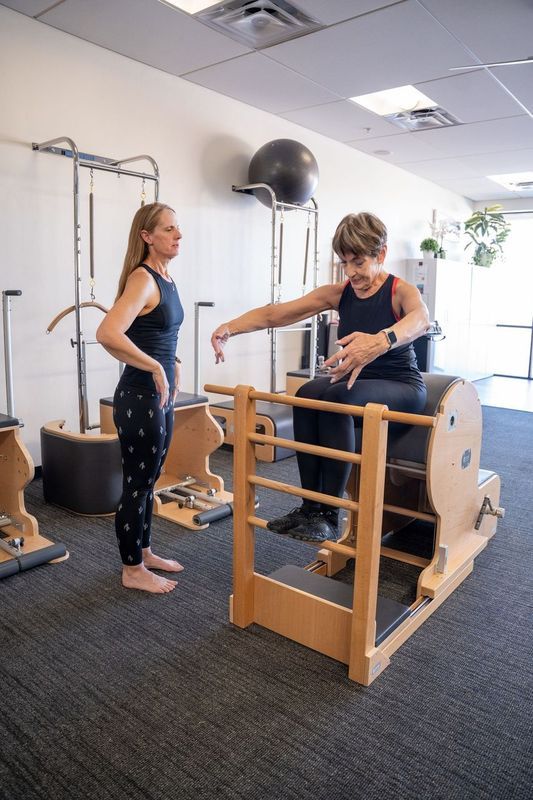
Our student teachers have unlimited opportunities to observe Swan's experienced teachers working with individual clients, duets, and quartets.
They can see different teachers approach the same movement, recognize different physical capabilities, and make decisions according to the needs of the person before them while honoring the Pilates principles and repertoire.
They can ask questions of Swan's teachers, explore what they've observed, and deepen their understanding through conversation and feedback.
They also have access to Shannon, whose experience as a Swan teacher and BASI Faculty member makes her feedback invaluable.
Our fully equipped studio and state-of-the-art apparatus are available for unlimited student practice. Students can work independently, practice with one another, and develop their teaching skills with individual clients, duets, and groups.
Psychologist Barbara Rogoff explored another dimension of learning that I find especially relevant to what we offer at Swan. In Apprenticeship in Thinking, she examined how understanding develops through guided participation in shared activities with more experienced people.
Her research concerned learning in social and developmental contexts, rather than Pilates teacher education. But the principle is meaningful here: students have opportunities to learn not only from what experienced teachers explain, but from participating alongside them, observing their decisions, and gradually taking greater responsibility for the work themselves.
What matters to me is not simply the amount of time students spend in the studio.
It's what becomes possible through repeated exposure to excellent teaching, thoughtful practice, and the willingness of experienced professionals to share what they know.
Our intention extends beyond preparing students for their BASI examinations. We want to help them develop professional capabilities they will continue building throughout their teaching careers.
What the Client Ultimately Experiences
When I observe a Pilates session, I pay close attention to the experience of the client.
I ask myself: Does this teacher know how to create opportunities for success for their client?
Was the client given opportunities to discover and develop their capabilities?
The client may be challenged, considerably so, but did the teacher prepare them to meet that challenge?
This is something I've explored in Safety Is the Gateway to Strength: how feeling secure and supported can create the conditions for meaningful progress.
The client may never know the hours of study, practice, and dedication their teacher has invested to truly know the art and science of Pilates.
But they will see, feel, and hopefully digest it.
BASI provides the rigor of comprehensive Pilates education, and Swan provides a deliberate learning environment.
All with the goal of developing Pilates teachers who help clients discover capabilities and possibilities they hadn't recognized for themselves.
The student becomes the teacher. The teacher becomes a stealth agent for change.
Research and Further Reading
- Donald A. Schön: Educating the Reflective Practitioner: Toward a New Design for Teaching and Learning in the Professions (1987). Jossey-Bass.
- Jean Lave and Etienne Wenger: Situated Learning: Legitimate Peripheral Participation (1991). Cambridge University Press.
- Barbara Rogoff: Apprenticeship in Thinking: Cognitive Development in Social Context (1990). Oxford University Press.
These works inform the discussion of professional learning, guided participation, coaching, and reflection. Their application to Swan's teacher-education environment is Susan Swan's interpretation.