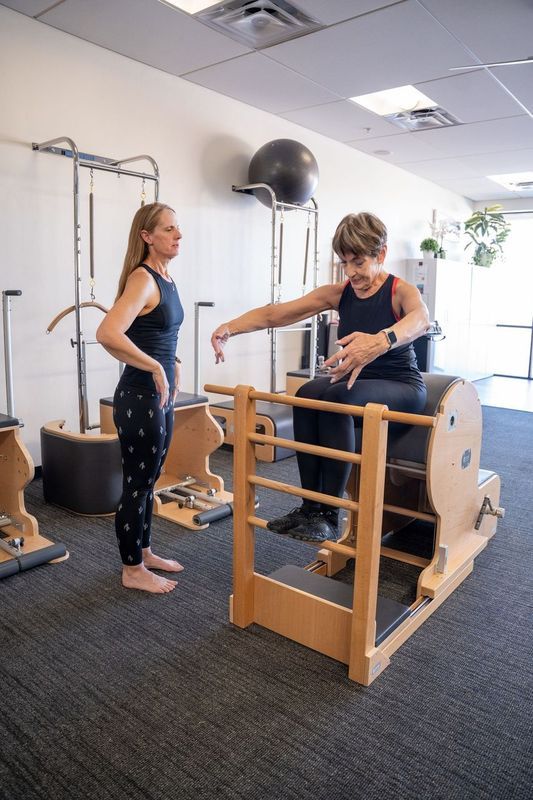
The Responsibility and Privilege of Teaching

By Susan Swan
Essay 1 | November 19, 2026
In 2018, I was working as the Director of Nursing at a well-known drug and alcohol addiction treatment facility during the day and teaching Pilates in the evenings.
I had loved nursing throughout my career. Every position I'd held had challenged me, stimulated my curiosity, and given me opportunities to contribute something meaningful to the lives of patients and colleagues.
Then the treatment facility was sold to a corporation.
The transition was difficult. Over time, I came to feel that what mattered most to the new organization was my legal authority to put RN after my name, a name on a line they prescribed. My decades of experience, professional judgment, and understanding of the people we served were irrelevant and unwelcome.
I was frustrated.
One day, I told our Medical Director, a person I had worked with for many years and respected enormously, "I've got to get out of here!"
"What would you do?" he asked.
"I'll teach Pilates."
"Why would you do that?" he replied with genuine disdain. "You are a trained professional."
I have thought about that conversation many times.
His response reflected an assumption that physical education and movement instruction somehow occupy a lesser place in the world of professional work. It was a belief I'd encountered before: if someone couldn't succeed academically, there was always—P.E.
I understood where that assumption came from. I also knew, from my own experience, how mistaken it was.
What I found particularly interesting was that the conversation seemed to place my nursing education and my Pilates teaching on opposite sides of a professional divide. Yet everything I had learned about human beings throughout my nursing career was becoming increasingly valuable in my teaching.
I wasn't abandoning professional knowledge. I was continuing to develop and apply it.
Something I Had to Do
When I first experienced Pilates, I knew almost immediately that I had encountered something extraordinary.
I didn't arrive at that conclusion through a careful comparison of career opportunities or an analysis of the fitness industry.
I simply knew that Pilates was something I must do. Whatever barriers appeared, I would find my way across them.
Nothing was going to deter me.
My own experience of Pilates had already changed me in ways I found difficult to put into words. But when I began teaching, something shifted again.
I was no longer only experiencing change in myself. I had the opportunity to participate in the possibility of change for others.
That experience deepened my understanding of what it means to serve another human being. It also made me increasingly aware of how much preparation, judgment, and responsibility excellent teaching requires.
The Person Before Us
When someone comes to a Pilates teacher, they bring much more than a body that needs exercise.
They bring their experiences, expectations, physical capabilities, apprehensions, aspirations, and the accumulated influences of a lifetime.
Some arrive confident and eager. Others have learned to regard their bodies as unreliable, troublesome, or disappointing. Many are simply curious about what might be possible.
We never know everything that has shaped the person standing before us. Nor do we need to.
What we do need is the preparation and judgment to meet that person with respect, curiosity, and an understanding of the responsibility we are accepting.
The work requires a substantial command of anatomy, movement, exercise selection, apparatus, and the principles of Pilates. It also requires observation, communication, adaptability, and the ability to recognize when an exercise or approach is inappropriate.
Knowing how to perform an exercise is not the same as knowing how to teach it to another human being.
And knowing how to teach it to one person does not mean we should teach it in precisely the same way to the next.
Every person deserves to be understood as an individual.
That understanding changes the questions a teacher asks. Rather than beginning with what exercises are scheduled for the session, we consider what the person is capable of today, what they want to accomplish, and what experiences might help them develop further.
The distinction is central to the kind of teaching we practice at Swan.
The Difference Between Knowing and Understanding
During my nursing career, I came to appreciate how much professional judgment develops through experience.
Patricia Benner, a nursing scholar whose work I find especially relevant to this discussion, explored how professionals develop expertise in From Novice to Expert. Her work describes the progression from relying on learned rules to recognizing the significance of individual circumstances through experience and judgment.
That is something I recognize from nursing, and increasingly from Pilates.
A beginning teacher may be able to describe an exercise accurately, identify the muscles involved, and demonstrate the appropriate apparatus settings.
An experienced teacher may recognize, within moments, that the exercise should be modified, approached differently, or set aside altogether.
The difference involves observation, pattern recognition, practical experience, and an appreciation of the individual rather than the exercise alone.
Some of the most consequential knowledge in an applied profession develops through repeated encounters with real human situations. It cannot be fully appreciated by looking at a credential or job title.
That judgment is not a substitute for education. It grows from education, experience, observation, reflection, and a continuing willingness to learn.
The best teachers I know have never considered themselves finished students.
I certainly don't.
After more than four decades in nursing and 15 years teaching Pilates, I continue to discover more.
The Art of a Winnable Challenge
One of the great privileges of teaching is helping another person discover capabilities they may not yet recognize in themselves.
This requires more than selecting exercises of increasing difficulty.
I think of it as presenting deliberate, winnable challenges.
The teacher observes the client's Individual Physical Capability, considers their goals, and offers a challenge that invites genuine effort while making success attainable.
The client meets that challenge. Something changes. Perhaps they discover greater strength, coordination, balance, or confidence. Perhaps they recognize that an assumption about their physical limitations was mistaken.
Then we consider the next challenge.
This is not about making every exercise easy or guaranteeing success on every attempt. The challenge must be meaningful, and learning often involves experimentation, mistakes, and adjustment.
The skill lies in recognizing what is appropriate for this person, at this moment, and allowing the experience to inform what happens next.
Movement-learning researchers Gabriele Wulf and Rebecca Lewthwaite have investigated how expectations of success, learner autonomy, and attentional focus influence motor performance and learning. Their OPTIMAL theory provides a valuable scientific perspective on the conditions that can support the development of movement skills.
I find their work particularly relevant because it recognizes the learner as an active participant.
The teacher can design the experience, offer information, observe, and adjust. The client is the person doing the learning.
This idea also connects to the work of motor-learning researchers who have examined how people discover movement solutions through interactions among their individual capabilities, the task, and the environment.
At Swan, we've explored these questions further in Your Body and Your Brain Need Options and Practice Doesn't Make Perfect. It Makes Familiar.
The essential point is that the teacher's knowledge is used in service of the client's developing capability.
The wins belong to the client.
And as human beings continue evolving through their experiences, the possibilities for new challenges continue evolving, too.
The Privilege of Not Needing to Know the Story
One of the ideas I find especially compelling is that we can help people change their relationship with their bodies without ever knowing all the experiences that shaped it.
I sometimes think of Pilates teachers as stealth agents for change.
A person discovers that they can balance, coordinate, or accomplish something they once considered beyond their ability. They begin trusting their own judgment about what feels appropriate. They experience the satisfaction of meeting a challenge they weren't certain they could meet.
We don't need to know every reason someone doubts their physical capabilities to help them discover new possibilities.
Our responsibility is to bring our knowledge, observation, and judgment to the experience while respecting the client's choices and goals.
The teacher contributes appropriate challenges, encouragement, and an environment in which discovery becomes possible.
The client is the owner.
Is Being a Pilates Teacher a Calling?
During my nursing career, I encountered many ways of thinking about the responsibilities we accept when caring for another human being.
Jean Watson's work on human caring speaks to something I've valued throughout my professional life: the importance of being fully present with the person before us.
Watson's Theory of Human Caring and Caritas Processes explore human dignity, authentic presence, and the intentional quality of professional relationships.
The philosopher Martin Buber approached the human relationship from another direction. In I and Thou, he explored what it means to encounter another person as a human presence rather than simply an object of observation.
I find these ideas meaningful because they speak to the quality of our attention and the way we understand the person we're serving.
For me, the sacredness of teaching arises from my understanding that the human being before me is never merely a physical problem to solve or a set of exercises to supervise.
That person has a life, a history, a capacity for choice, and possibilities that neither of us can fully anticipate.
My responsibility is to bring the best of my preparation, judgment, experience, and attention to our work together while respecting that person's sovereignty.
It is not my place to determine what another human being should become or where the limits of their capabilities lie.
It is my privilege to present deliberate challenges, recognize the client's achievements, and continue offering opportunities for development.
The client meets a challenge, discovers something about their capabilities, and becomes ready to explore what comes next.
Winning is winning and evolving.
And the teacher evolves through these experiences, too.
That is part of what makes this work so meaningful to me.
Preparing for the Responsibility
This is why I care so deeply about Pilates teacher education.
In my opinion, comprehensive preparation matters. Understanding the Pilates system, studying anatomy and movement, practicing the apparatus, observing accomplished teachers, and learning to work with different individuals all contribute to the foundation of professional competence.
At Swan, we have chosen to host BASI Pilates teacher education because we value BASI's thorough comprehensive preparation and the possibilities for continuing professional development within its international educational community.
Students have opportunities to observe experienced teachers, practice on the apparatus, and develop their skills within a working Pilates studio.
A teaching certificate is not the conclusion of a teacher's education.
It is a meaningful achievement within a much longer process.
I want aspiring teachers to consider the kind of professional they are preparing to become.
Would they entrust their own body to that person?
Would they entrust the bodies of the people they love?
Would they trust that teacher to recognize the limits of their knowledge, exercise sound judgment, and continue learning throughout their career?
Those are demanding questions. They should be.
Because the responsibility is substantial, and the privilege is extraordinary.
A Profession Worthy of Our Highest Aspirations
I still remember my Medical Director's question.
"Why would you do that? You are a trained professional."
I had been a trained professional throughout my nursing career, and I remain deeply grateful for everything that profession taught me.
I didn't leave that understanding behind when I began teaching Pilates.
I brought it with me.
And Pilates has continued to deepen my understanding of human development, professional responsibility, and the extraordinary possibilities that emerge when people participate consciously in their own physical lives.
I would like aspiring Pilates teachers to understand that they are entering a profession worthy of serious intellectual preparation, disciplined practice, sound judgment, and profound respect for the people they will serve.
A profession in which technical knowledge and human understanding must continue developing together.
A profession in which the teacher remains a student.
And a profession in which the opportunity to contribute to another person's development is both a responsibility and a privilege.
For me, that is a sacred endeavor.
Research and Further Reading
- Patricia Benner: From Novice to Expert: Excellence and Power in Clinical Nursing Practice (1984); “Uncovering the Knowledge Embedded in Clinical Practice” (1983).
- Gabriele Wulf and Rebecca Lewthwaite: “Optimizing Performance Through Intrinsic Motivation and Attention for Learning: The OPTIMAL Theory of Motor Learning” (2016), Psychonomic Bulletin & Review.
- Karl Newell: “Constraints on the Development of Coordination” (1986), in Motor Development in Children: Aspects of Coordination and Control.
- Jean Watson: Nursing: The Philosophy and Science of Caring (1979; revised edition 2008), and the Watson Caring Science Institute's Caritas Processes.
- Martin Buber: I and Thou (1923).
Continue Exploring Swan Originals
- Your Body and Your Brain Need Options — How teachers create conditions for movement discovery.
- Practice Doesn't Make Perfect. It Makes Familiar. — Why repetition and learning are not identical.
- We Are More Changeable Than We Think — The possibilities for continued human development.
- Safety Is the Gateway to Strength — The relationship between safety, confidence, and physical progress.
- Why AI Will Never Master Pilates (And That's a Good Thing) — Human judgment, observation, and the teaching relationship.